Posted on

The Carpathian Mountains: A Dream Come True

If you had told us years ago that we’d one day be sourcing Amanita mushrooms from the legendary Carpathian Mountains, we probably wouldn’t have believed you.

Yet here we are.

As an educational apothecary, we’re endlessly fascinated by where plants and fungi come from. Every landscape tells a story. Every ecosystem shapes the life growing within it.

And few places capture the imagination quite like the Carpathian Mountains.

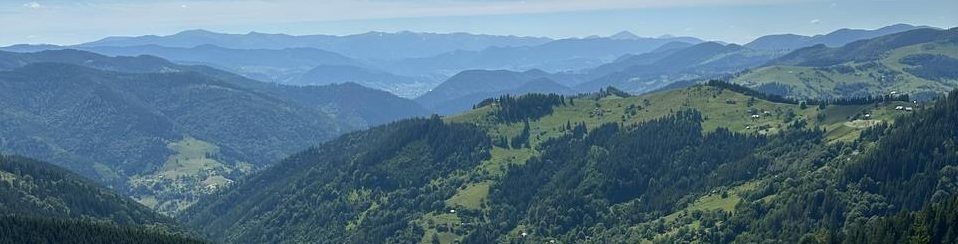
Stretching across Eastern Europe, the Carpathians are home to some of the largest remaining old-growth and wild forests on Earth. Vast stands of spruce, fir, pine, and birch create the ideal environment for Amanita mushrooms to thrive naturally, just as they have for thousands of years.

The Carpathian Mountains offer clean air, abundant rainfall, rich forest ecosystems, and generations of traditional foraging knowledge. These forests remain relatively untouched compared to many heavily developed regions of the world, allowing Amanita to grow in the environment nature intended.

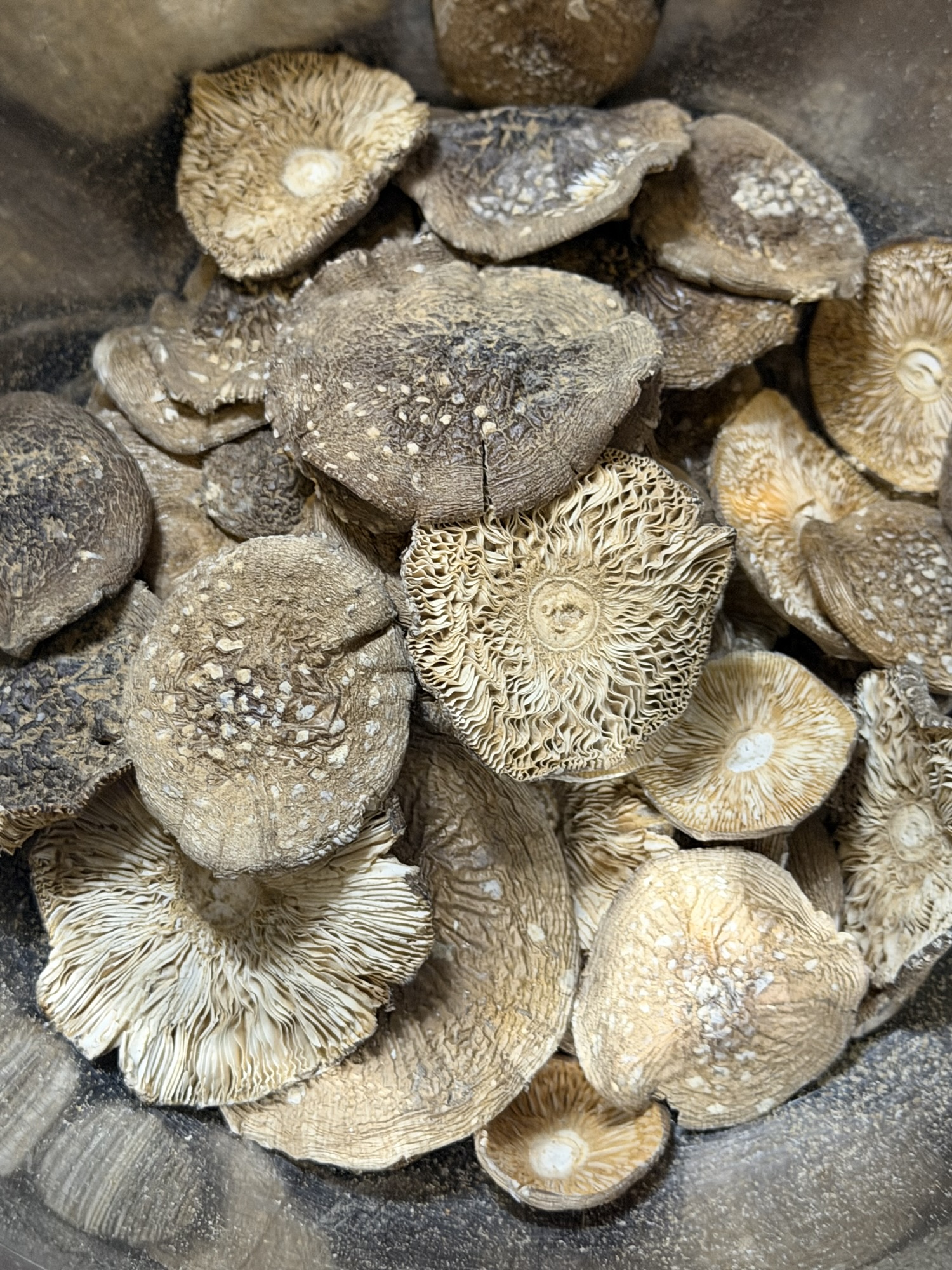
Our mushrooms are wild-foraged during peak season, carefully selected, and gently dried at low temperatures to preserve their natural characteristics.

One of the reasons we value these forests so deeply is because Amanita mushrooms cannot be farmed like most mushrooms.

Unlike Lion’s Mane, Oyster mushrooms, or Reishi, Amanita forms a living relationship with trees. Beneath the forest floor, its mycelium intertwines with the roots of spruce, pine, fir, and birch in a partnership known as mycorrhizae. The tree provides sugars produced through photosynthesis, while the fungus helps the tree access water and nutrients from the soil.

Without the forest, there is no Amanita.

This relationship is one reason Amanita has resisted large-scale cultivation. While many functional mushrooms can be grown indoors on sawdust or grain, Amanita depends on a thriving ecosystem and living tree partners to complete its life cycle.

That’s one reason the Carpathian Mountains have become so important to us.

These forests remain among the wildest and most ecologically rich landscapes in Europe. Walking through them feels like stepping into another world—one where nature still sets the pace.

For us, sourcing Carpathian Mountain Amanita isn’t simply about obtaining mushrooms.

It’s about honoring the forest they come from.

It’s about understanding the relationship between fungi, trees, soil, rain, season, and place.

Most of all, it’s about sharing that story with you.

Because every mushroom begins long before it reaches your hands.

It begins in the forest.

Did You Know?

The mushroom you see above the ground is only a small part of the organism.

The true body of the fungus exists underground as a vast network of mycelium. In healthy forests, these networks can connect multiple trees, moving water, nutrients, and chemical signals throughout the ecosystem.

Some researchers have even nicknamed these underground networks the “wood wide web.”

When an Amanita mushroom emerges from the forest floor, it’s the fruiting body of an organism that may have been living beneath the soil for years.

The next time you see an Amanita, consider what you’re actually looking at.

Not just a mushroom.

But the visible expression of an ancient partnership between fungi, trees, soil, water, and time—a relationship that has helped shape forests for millions of years.

A panoramic view of lush green mountains and rolling hills under a clear blue sky.
Posted on

Ibotenic Acid Vs Muscimol

Ibotenic Acid vs. Muscimol is a great place to begin understanding how to work with Amanita.

These two words don’t need to be scary. Let’s tackle them one at a time.

Ibotenic Acid

This word seems to trigger fear immediately.

“Did you say acid?”

“Isn’t that dangerous?”

“I heard ibotenic acid is neurotoxic!”

Let’s slow down for a moment and think back to science class when we learned about acids and bases.

Funny enough, those lessons were the beginning of alchemy. We just didn’t realize we’d be applying them later in life.

So let’s clear up one of the most common statements you’ll hear:

“Ibotenic acid is neurotoxic.”

Where does that claim come from?

Scientists.

Specifically, neuroscientists.

For decades, researchers have used ibotenic acid as a laboratory tool. In these experiments, concentrated ibotenic acid was injected directly into the brains of mice and rats to intentionally damage specific groups of neurons.

The goal was not healing, nutrition, and certainly not studying Amanita consumption.

The goal was to create controlled brain lesions so researchers could study what happened when those neurons died.

That’s an important distinction.

The reason many Amanita researchers and enthusiasts object when these studies are cited is because one critical detail is often left out:

The ibotenic acid was injected directly into brain tissue. It was not eaten.

Direct intracerebral injection and oral consumption are completely different routes of exposure.

So let’s be clear:

  • Was neuronal degeneration the intended outcome of the experiment? Yes.
  • Was that beneficial to the animal? No.
  • Was the experiment designed to create brain damage? Yes.
  • Does this prove that eating Amanita mushrooms causes the same type of damage? No.

The famous title “Ibotenic Acid-Induced Neuronal Degeneration” is essentially saying:

“We injected ibotenic acid into brain tissue and observed neuronal degeneration.”

That’s exactly what the researchers set out to do.

So can we please stop pretending that a laboratory brain-injection study automatically tells us what happens when someone consumes Amanita traditionally?

Now, does that mean ibotenic acid is completely irrelevant?

Absolutely not.

Ibotenic acid is considered the more stimulating and excitatory compound naturally found in Amanita mushrooms. Many people report feeling more energized, alert, physically active, creative, or mentally stimulated when higher amounts of ibotenic acid are present.

This is why understanding the difference between partially decarbed (35%) Amanita and fully decarbed Amanita matters.

And that brings us to muscimol.

Muscimol

If ibotenic acid gets most of the fear, muscimol gets most of the attention.

Muscimol is the primary compound produced when ibotenic acid is converted through the decarboxylation process.

While ibotenic acid is often associated with stimulation and excitation, muscimol is generally associated with calm, relaxation, dream-like states, introspection, altered perception, and deep rest.

Unlike ibotenic acid, muscimol primarily interacts with the GABA system, which is involved in slowing down neural activity rather than exciting it.

This is one reason many people describe fully decarbed Amanita as feeling completely different from partially decarbed Amanita.

Some report:

  • Deep relaxation
  • Improved sleep
  • Vivid dreams
  • Enhanced meditation
  • A sense of stillness or inner quiet
  • Reduced mental chatter

Of course, experiences vary from person to person, and factors such as dose, body chemistry, mushroom variety, and preparation method all play a role.

The important takeaway is that muscimol is not simply “stronger ibotenic acid.”

It is a different compound with a different mechanism and a different experience.

Ibotenic Acid vs. Muscimol

Now that we’ve met both compounds, the conversation becomes much easier.

Many discussions around Amanita make it sound as though ibotenic acid is the villain and muscimol is the hero.

Reality is usually more nuanced.

Both compounds naturally exist within Amanita mushrooms.

The real question isn’t which one is “good” or “bad.”

The real question is:

What experience are you looking for?

Higher ibotenic acid preparations may feel more stimulating, active, energizing, and outwardly focused.

Higher muscimol preparations may feel more calming, dreamlike, relaxing, and inwardly focused.

Neither compound should be understood through fear alone.

Understanding Amanita begins when we stop viewing these compounds as good versus bad and start understanding them as different expressions of the same mushroom.

The more we learn, the less we fear.

And the less we fear, the more clearly, we can think beyond.

A Quick Note on Individual Responses

At this point, it’s important to remember that these descriptions are general patterns, not universal rules.

Many people report that ibotenic-acid-forward preparations feel more stimulating, while muscimol-forward preparations feel more calming. However, not everyone experiences Amanita this way.

Some individuals report the exact opposite.

They find that ibotenic acid makes them sleepy, relaxed, or ready for bed, while muscimol leaves them feeling clear, energized, focused, and productive.

How is that possible?

The answer is simple: the mushroom is interacting with a unique nervous system.

No two people have identical brain chemistry, receptor sensitivity, life experiences, stress levels, sleep quality, nutritional status, or baseline nervous system activity.

What feels stimulating to one person may feel grounding to another.

What feels sedating to one person may feel liberating to another.

In some cases, what appears to be “energy” is actually the result of reduced mental noise. When the mind becomes quieter, people often discover they have more energy available than they realized.

Likewise, what appears to be “sedation” may actually be the body’s way of catching up on needed rest.

This is one reason personal experimentation, careful observation, journaling, and patience are so valuable when working with Amanita.

The goal isn’t to force your experience to match someone else’s.

The goal is to understand how your body responds.

The Sweat Factor

Another interesting observation comes from individuals who intentionally seek Amanita preparations that retain a portion of their naturally occurring ibotenic acid.

Some users report increased sweating and describe the experience as deeply cleansing. In certain circles, people even compare the sensation to a sweat lodge or sauna experience.

Scientifically, sweating is primarily a regulatory process used by the body for temperature control and nervous system responses. It is not generally considered the body’s primary detoxification pathway.

Yet many people still describe these experiences as physically, emotionally, or energetically releasing.

Whether viewed through a physiological lens or an esoteric one, sweat can represent movement.

Something that was stagnant begins flowing.

Something that was held begins releasing.

For this reason, some Amanita users intentionally prefer preparations that retain a percentage of ibotenic acid rather than pursuing complete conversion to muscimol.

Neither approach is inherently right or wrong.

They simply represent different relationships with the same mushroom.

So, what will you choose when it comes to ibotenic acid vs muscimol?

Posted on

Amanita Pantherina: most misunderstood Amanita mushrooms

Amanita Pantherina: most misunderstood Amanita mushrooms


Not because it’s “dangerous.”

Not because it’s “bad.”

Because it’s different.


Most people approach mushrooms through stimulation, visuals, or intensity.

But Amanita Pantherina can move in the opposite direction
— toward stillness, heaviness, introspection, dream states, and deep nervous system slowing.

And unlike weak tinctures or watered-down Amanita products online, properly prepared Pantherina Slurry contains naturally high concentrations of muscimol and related compounds many seekers describe as grounding, immersive, and profoundly calming.


But here’s what most people don’t realize:

Preparation changes everything.


Amanita Pantherina became known for a reason.

Not because it’s “dangerous.”

Not because it’s “bad.”

Because it’s different.


Most people approach mushrooms through stimulation, visuals, or intensity.

But Amanita Pantherina can move in the opposite direction
— toward stillness, heaviness, introspection, dream states, and deep nervous system slowing.

And unlike weak tinctures or watered-down Amanita products online, properly prepared Pantherina Slurry contains naturally high concentrations of muscimol and related compounds many seekers describe as grounding, immersive, and profoundly calming.


But here’s what most people don’t realize:

Preparation changes everything.

A poorly prepared Amanita product can feel inconsistent, overstimulating, confusing, or physically uncomfortable due to excess ibotenic acid and incomplete conversion methods.

That’s why Awakening Roots focuses on fully converted Pantherina Slurry methods — not mystery extracts, “proprietary blends,” or alcohol tinctures that often lack consistency and full-spectrum depth.

Our Pantherina Slurry process focuses on:
→ Proper low-pH conversion
→ Controlled heat and time
→ Full-spectrum mushroom material
→ Consistency seekers can actually work with
→ Educational understanding instead of fear-based marketing


Many people describe Amanita Pantherina effects as:
→ deeply calming
→ physically grounding
→ dreamlike
→ introspective
→ meditative
→ sedating without chaotic stimulation


Some even compare Pantherina Slurry more to conscious stillness than a traditional “trip.”

pantherina slurry


And unlike products centered around stimulation and dopamine chasing, Amanita Pantherina often invites the body into rest, silence, and inward awareness.

That’s why experienced Amanita seekers eventually become curious about Pantherina Slurry.

Not because it’s louder.

Because it’s quieter.

Because underneath the myths, fear, and internet exaggeration is one of the most misunderstood Amanita mushrooms in existence.

And understanding changes everything.

Learn More


🍄If you made it this far and want to Learn More About Amanita Pantherina, Pantherina Slurry, Muscimol, and Full Conversion Methods with me book a consultation, let’s dive deeper.

With love,
Marlucia
Awakening Roots — Since 2019

P.S. Shout outs on social media (Reddit) are so helpful to the cause. Make sure you tag us so you get CREDIT! Want even more perks? Join our affiliate program.

* Disclaimer: For educational purposes only. This information has not been evaluated by the Food and Drug Administration. This information is not intended to diagnose, treat, cure, or prevent any disease.    
Posted on

Decarboxylation: Wake You Up and Rock You to Sleep!

Decarboxylation is one of those words that sounds technical until you realize it simply explains why the same mushroom can feel completely different depending on how it’s prepared.

In the world of muscaria, regalis, and pantherina, this process is what shifts an experience from stimulating, sweaty, and deeply somatic to calming, grounding, and sleep-supportive.

These three species do behave differently in some ways—but when it comes to decarboxylation, there’s good news:
they all decarb the same way.
That means once you understand this process, you only need to learn it once.


How decarboxylation works

Decarboxylation happens when three conditions work together, in this order:

1. Citric acid — preparation

Citric acid creates the right environment by gently lowering the pH. This makes the compound more receptive to change.

On its own, citric acid does not cause decarboxylation.
Nothing is removed yet.
It simply prepares the compound so the next steps can work efficiently.

This is why lemon juice isn’t ideal. While lemon contains citric acid, it also contains sugars, fibers, oils, and highly variable acidity. That inconsistency makes the process unreliable. Pure citric acid, on the other hand, is stable and predictable.

There’s also a practical reason: citric acid works in tiny amounts. Lemon juice does not—you’d need so much of it that it overwhelms the preparation and becomes unpalatable.

2. Heat — activation

Heat supplies the energy needed for the change to begin.
This is where the structure can actually shift.

Without heat, the process stalls.
With heat, decarboxylation becomes possible.

3. Time — completion

Time allows the change to finish and stabilize.

Rushing this step leaves the process incomplete.
Given enough time, the conversion settles fully.


Why this matters

Using acid alone prepares but does not convert.
Using heat alone can be uneven or inefficient.
Using heat without time results in partial conversion.

When citric acid, heat, and time work together, the process becomes intentional instead of accidental.

That’s decarboxylation—nothing mystical, nothing forced—just the right conditions aligned so the change can actually occur.


About dehydration and “partial decarb”

One important thing to understand is that all of our specimens already begin at roughly 35% decarboxylated. This happens during dehydration.

Heat alone does cause decarboxylation—just like with cannabis. So if you’re thinking, “Wait, I thought drying the mushroom already decarbed it?” — you’re not wrong.

What heat does is start the process.
But heat by itself only takes it so far.

To move beyond that baseline and continue converting toward a fuller muscimol expression, additional conditions are needed. That’s where environment and method come in. Dehydration initiates decarboxylation; intentional preparation is what carries it the rest of the way.


If you want to walk through the process yourself, you can check out our DIY Decarb guide. And if the science still feels fuzzy—or you’d rather skip the steps entirely—you can always let us handle the conversion for you and grab a Slurry instead.

Posted on

Amanita Myth Buster: Part 2

Amanita Myth Buster Part 2 🍄 More Myths, More Laughs, Let’s explore the Mushroom Facts!

As promised—and because misinformation multiplies faster than mycelium after rain—this round of Amanita Myth Buster Part 2 goes deeper, fizzier, and even funnier.

Strap in, Seekers. Goggles on. Science meets sarcasm.

Amanita Myth #1: “If I drink a carbonated beverage after Amanita, it’ll recarboxylate it.”

Verdict: Explosively Busted.
No, your soda can’t undo chemistry. Decarboxylation is a one-way ticket—heat + acidic pH = ibotenic acid → muscimol. Carbonation is just CO₂ dissolved in water. It’ll make you burp, not rewind molecular history. If bubbles fixed chemistry, Coke Zero would be a Nobel-winning solvent.


Amanita Myth #2: “Amanita is the toadstool.”

Verdict: Half-True but Technically Wrong.
Only Amanita muscaria wears the red-cap-white-spot crown. “Toadstool” is old European slang for any mushroom that looked magical or menacing. So while muscaria is the poster child (and the emoji 🍄), her cousins — regalis, pantherina, and the deadly amatoxins — don’t get that fairytale branding.


Amanita Myth #3: “You can tell potency by cap color.”

Verdict: Busted with style.
Color isn’t chemistry. Sunlight, drying, and soil all change pigment. A deep crimson cap might have less muscimol than a faded orange one. Potency comes from genetics + environment + preparation, not from who wore the brightest hat to the forest party.


Amanita Myth #4: “Freezing raw Amanita will decarb it.”

Verdict: Frostbitten False.
Freezing pauses chemistry—it doesn’t complete it. Ibotenic acid won’t politely convert to muscimol because it’s cold; it needs sustained heat and controlled pH. A freezer just preserves the status quo, like putting unbaked cookies in cryosleep.


Amanita Myth #5: “All Amanita species do the same thing.”

Verdict: Scientifically Splattered.
The genus Amanita has more than six hundred species. Some enlighten, some intoxicate, some assassinate.

At Awakening Roots, we only work with three:

Amanita muscaria and Amanita regalis (muscarioids)

Amanita pantherina (pantherinoid)


None contain amatoxins.

So when people say “Amanita did this to me,” the follow-up question should always be: which one?


Amanita Myth #6: “Santa Claus came from Amanita.”

Verdict: Ho-Ho-Half True.
This one’s a festive blend of anthropology, shamanism, and speculation.
Yes — there’s truth in the story: Siberian shamans were known to consume Amanita muscaria, dry the caps by hanging them near the fire (sometimes in stockings), and enter yurts through the smoke hole when snow blocked the door — red-clad figures delivering spiritual “gifts.”
Those details did influence early depictions of Santa: red and white robes, reindeer (native to those regions), and winter solstice rituals honoring the return of the sun.

But modern Coca-Cola Santa? That’s a 20th-century marketing glow-up. The Amanita myth may have birthed his vibe, not his Visa commercials.
So yes — the shamanic Santa probably flew high on muscimol, but the mall Santa just flies on caffeine and capitalism.


So there you have it—six more myths knocked off their caps. No soda miracles, no color-coded potions, and no frost-powered alchemy.

Just science, story, and reverence for the mushroom that refuses to fit in anyone’s neat little box.

Stay curious. Stay grounded. And always—Think beyond.

Check out our YOUTUBE channel where we come alive with educating you to Awaken to your Roots.

Posted on

Amanita Myth Buster

Amanita Myth Busters 🍄 Breaking Down the Funniest Myths About Fly Agaric with Facts, Humor, and a Dash of Reality

Welcome to Amanita Myth Buster Part 1

You’ve heard the legends — that Amanita will make you see Santa, talk to elves, or drop dead after one nibble.
But what’s real, what’s ridiculous, and what’s just Reddit being… Reddit?

Let’s talk about some myths and separate the muscimol from the malarkey!

MYTH #1: “Amanita muscaria will kill you instantly.”

Verdict: Busted.


Despite its dramatic red-and-white “danger” outfit, Amanita muscaria is not a death cap in disguise. It contains no amatoxins (the real killers). The main actives — ibotenic acid and muscimol — can cause intense effects, but fatal cases are extraordinarily rare and nearly always involve huge, improperly prepared amounts. It’s psychoactive, not poisonous in the classical sense.


MYTH #2: “It’s basically the Mario mushroom.”
Verdict: Half True, Half Goofy.


Yes, the visuals inspired Mario’s power-up — that’s the truth. But no, you won’t suddenly double in size or bop bricks with your head. The only thing growing is your awareness (and possibly your appreciation for good decarb technique – like Slurry).


MYTH #3: “If it doesn’t make you trip, it’s fake.”
Verdict: Busted.


Muscimol is subtle. For some, it’s grounding, sedating, dreamy; for others, euphoric or body-light. No two nervous systems are the same. Amanita works more like a mirror than a megaphone — it reflects you, not a cinematic hallucination reel.


MYTH #4: “Pantherina is evil twin energy.”
Verdict: Myth with a twist.


Pantherina is stronger, yes — higher muscimol, lower ibotenic acid — but it’s not “evil.” It just plays in a different octave. Muscaria and Regalis are the choir; Pantherina is the soloist with range and a little attitude.


MYTH #5: “You can’t mix science and spirit.”
Verdict: Comically Busted.


That’s like saying you can’t mix water and tea leaves. Amanita’s whole mystery is where chemistry meets consciousness — 1 part molecular alchemy, 1 part metaphysical feedback loop, shaken not stirred.


MYTH #6: “Real shamans eat them raw.”
Verdict: Mostly Myth.


Traditional use varies, but most indigenous groups prepared them — drying, fermenting, or decarbing to transform ibotenic acid into muscimol. Raw Amanita is like unroasted coffee beans: possible, but not enjoyable.


So there you have it — six myths dismantled, one mushroom redeemed, and zero elves harmed in the making of this post.

Amanita muscaria, regalis, and pantherina aren’t party drugs or death traps — They are ancient, complex, and deserving of both respect and curiosity.

Check out our YOUTUBE channel where we come alive with educating you to Awaken to your Roots.

Posted on

How to use Amanita: Practical Guide

Amanita Practical Guide

If you’re new here, welcome. This is your How to use Amanita: Practical Guide, and I’ll keep it as simple as possible.

When I think of Amanita, I like to smile and say: “I’m-a-need-a…” Because that’s what this mushroom points to. I’m-a-need-a calmer mind. Or if you’re like my husband, I’m-a-need-a better night’s sleep. If you have been on the healing journey for a while but are still seeking you could say, I’m-a-need-a reset.


What Amanita Does

Amanita is not about tripping or escaping. It’s a biochemical tool that works on your central nervous system (CNS):

  • It quiets the mind.
  • It helps the body release built-up tension.
  • It shifts scattered energy into steadier rhythms.
  • It supports balance when hormones or neurotransmitters are out of sync.

In plain words: Amanita helps you become more aware of yourself and how your body is really doing.


The Three Amanitas We Work With

1. Muscaria (Red with White Spots)

  • The one most people recognize.
  • Gentle to moderate in effect.
  • Often chosen first for easing stress, improving sleep, and light reset.

2. Regalis (Golden-Brown Cap)

  • Less known, but deeply respected.
  • Balanced and steady; sits between Muscaria and Pantherina.
  • Helpful for mood support, grounding, and clarity.

3. Pantherina (Brown Cap with White Spots)

  • The strongest of the three.
  • Works more potently on the CNS.
  • Best suited for those who already have experience or feel ready for deeper intensity.

Clearing Up the Fear

Amanita is not psilocybin. They are completely different mushrooms.

  • Psilocybin affects serotonin and is known for psychedelic visuals.
  • Amanita acts on the GABA system — the part of the brain and body responsible for calm, sleep, and regulation.

So instead of a psychedelic trip, Amanita feels more like a nervous system reset: body tension lowers, the mind softens, and balance starts to return.


How to Work With Amanita

  • Choose your strength: Muscaria (gentle), Regalis (balanced), Pantherina (strong).
  • Start where you are: lighter first if you’re unsure.
  • Pay attention: notice how your body and mood shift over time.
  • Hold gratitude: for the awareness it gives, and for your body as a vessel capable of change.

Practical tips on how to use Amanita

Amanita isn’t magic and it isn’t myth. It’s a biochemical tool that helps calm the nervous system, restore balance, and bring you back to yourself.

So next time you hear the word Amanita, think:
“I’m-a-need-a…” balance, calm, and a new level of awareness.

We’ve talked about some of the science and the practical theory behind working with Amanita. But along this journey, I’ve also found that the right tools can make everything smoother, safer, and more consistent. Here are a few that I personally use and recommend when preparing Amanita:

When preparing Amanita, I like to keep things simple and consistent.

A compact digital gram scale is essential so you’re never guessing. (Great cooking tool!)

I use pure food-grade citric acid to adjust pH during preparation. (my son thinks its a yummy additive in bubbly water)

For portioning, freezer-safe silicone trays are invaluable for keeping servings consistent. (so many uses for this!)

Either method works fine—what matters most is consistency.

I usually pour my prepared Amanita into a glass mason jar and refrigerate it, then pour directly from the jar into . I keep it in the fridge and use them within the week.

To stay consistent, I always measure with the same stainless steel cup so I’m not guessing each time.

For trays, these 1.7 oz Firgi leak-proof silicone trays are a great choice, and these slightly larger silicone freezer trays work just as well—it just depends on what size you prefer.

Another simple tool I’ve found helpful are food-grade desiccant packs. They help keep things dry and fresh if you’re storing Amanita in jars or containers. A small pack goes a long way in preventing moisture from creeping in.

I also keep a journal nearby to track timing, dosage, and reflections.

These aren’t complicated or expensive tools, but they’ve been invaluable for making the process not only reliable, but repeatable.

These are affiliate links, so yes—I might make around 90 cents if you order through them. Nothing crazy. I share them so you don’t have to scroll forever searching. If you already have something at home that works, that’s great too—use what you’ve got.

Posted on

Reverse Tolerance with Amanita: Why Less Feels Like More Over Time

Reverse tolerance with Amanita muscaria is one of the most surprising parts of the journey. Unlike substances that require increasing your dose to feel effects, Amanita often works the opposite way—where the more you work with it, the less you need.

In this post, we’ll explore what reverse tolerance means, how it shows up with muscimol and ibotenic acid, and why tuning into your body matters more than chasing effects.

Reverse Tolerance with Amanita: Why Less Feels Like More Over Time

🍄 Understanding the gentle unraveling of your nervous system


🌿 What is Reverse Tolerance?

Reverse tolerance is a fascinating phenomenon where you need less of a substance over time to feel its effects—the opposite of what happens with most substances.

With Amanita (like muscaria, regalis, and pantherina), many users find that as their body learns to interact with muscimol—the primary active compound—smaller amounts feel deeper, more pronounced, and more energetically aligned.


🔄 Why Does This Happen with Amanita?

The science points to GABA-A receptor modulation. Muscimol acts as a GABA agonist, calming the central nervous system. Over time, your body sensitizes to this calming effect, especially if you’ve lived in a hypervigilant or fight-or-flight state.

But it’s not just chemistry.

It’s also your nervous system finally trusting the stillness.
The more often you enter that state, the more easily your body returns to it.

This is the magic of entrainment—your system learning a new rhythm.


✨ Personal Reflection: “I Didn’t Feel Anything”

The first time I worked with Amanita, I almost dismissed it.
I was expecting fireworks, colors, movement… but what I got was silence.

And at first, that felt like nothing.
But the more I sat with it, the more I realized—that silence was the medicine.
My body, for once, wasn’t bracing. My mind wasn’t spiraling.
And that calm… was so unfamiliar, I didn’t even know it was working.

Weeks later, I needed less. I wanted less.
Because the portal had opened.
My system remembered.


⚠️ Caution: Don’t Chase the Feeling

Reverse tolerance only works if you don’t override it.

If you keep increasing your dose to “feel something,” you may miss the beauty of subtlety.
You’re not supposed to need more. You’re supposed to feel more with less.

Stay with it.

Let the quiet unravel you. Let the medicine whisper.


🔍 Signs It’s Working (Even If You Think It’s Not)

  • You feel calmer during moments that used to activate you
  • You sleep more deeply
  • You respond instead of reacting
  • Your thoughts have more space between them
  • Your breath slows without you trying
  • You feel safe in your own body—maybe for the first time

🌱 Next Steps: Let It Unfold

If you’ve just begun working with Amanita and feel like it’s “not working,” that may be your greatest sign it actually is.
Your job is to stay consistent.

👉 Start small
👉 Stay with the same dose for at least a week
👉 Journal your shifts
👉 Don’t expect a “trip”—expect a return

A return to self.
To stillness.
To your natural rhythm.


🍄 Bonus: Want Support?

Check out our One Month Protocol

You don’t have to walk this path alone.

Book a 1:1 Amanita Consulting Session to:
✔ Understand your body’s unique response
✔ Fine-tune your preparation or dosing
✔ Ask questions you can’t find answers to online

Click here to book your session
First-time price: $55 for Tribe Members

Or if you’re just looking to get started:
Grab our ready-made Slurry or 35% decarb Microcapsules—gentle enough for beginners, strong enough for regulars.
Or if you’d rather not DIY your preparation, grab a ready-made Slurry or 35% decarb Microcapsules—gentle enough for beginners, strong enough for regulars.


Stay curious. Stay grounded.
And always—Think Beyond.

🌀 With love,
Marlucia1. What Is Reverse Tolerance?

Posted on

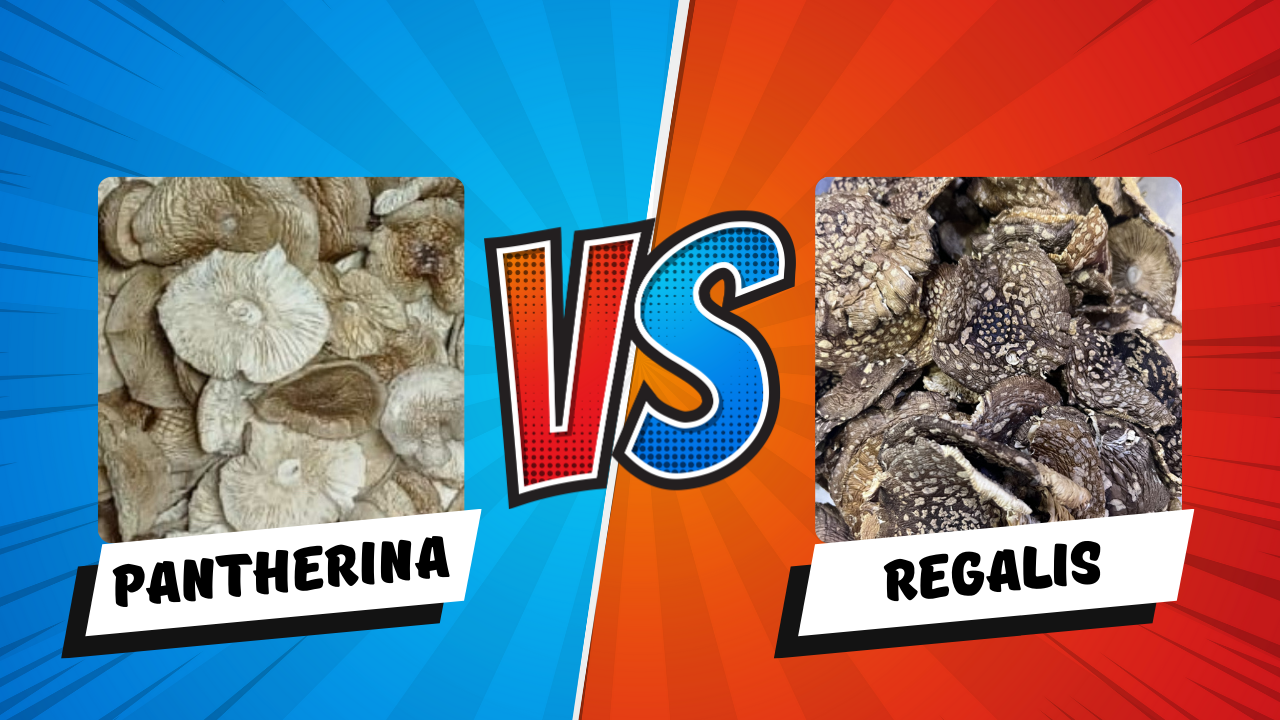
Pantherina vs. Regalis: My experience on higher doses of Amanita

Let’s talk about my experience with higher doses of Amanita. Specifically, Pantherina Vs Regalis.

I personally find myself gravitating toward the pantherinoid group rather than the muscarioid group.

Now, while regalis is an incredibly beautiful and powerful mushroom, it does fall under the muscarioid category. Because of that, it naturally carries higher concentrations of muscarine.

At lower doses, that isn’t usually a problem. Once the dose is pushed higher, I begin experiencing very noticeable muscarinic effects.

For me that shows up as profuse sweating and excessive salivation, which can quickly become uncomfortable and distracting.

For that reason, when I’m looking to go deeper with Amanita, I choose pantherina as my preferred ally.

That being said, even with pantherina, I approach with great caution. This is not a mushroom to take lightly. While it can open remarkable doors, too much Amanita is never enjoyable.

The experience demands respect, and overindulgence comes with consequences.

If you ignore that and push too far, Amanita has a way of “slapping you back,” and it can be a very harsh and humbling lesson.

So in short, while regalis and pantherina are my two favorites, when it comes to higher-dose journeys, pantherina is the tool I trust. But always with reverence, always with restraint, and always remembering that Amanita is a teacher best approached with respect rather than excess.

I hope that gave you some insight on Pantherina vs. Regalis and my experience with higher doses of Amanita. Out of all the varieties, those two are my personal favorites to work with.

Posted on

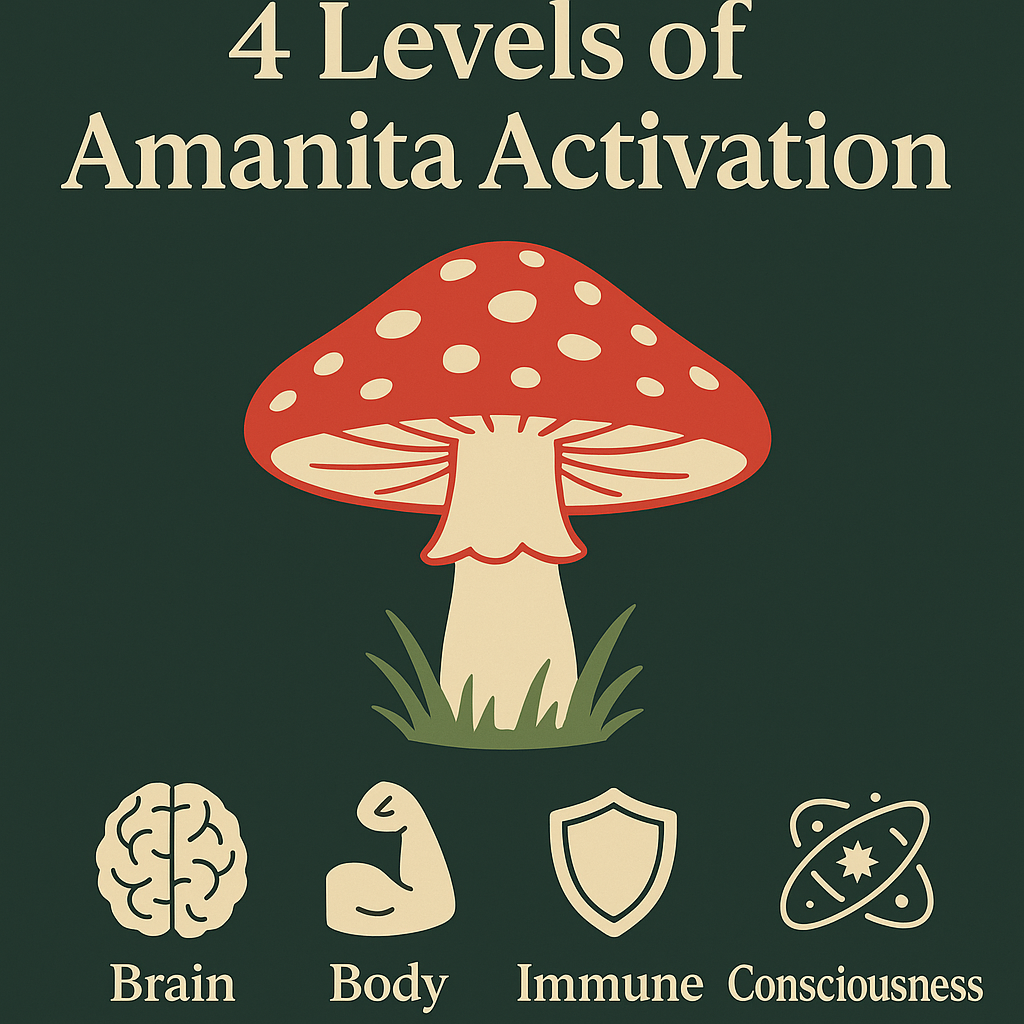
4 Levels of Amanita Activation

Amanita Activation

🍄 The 4 levels of Amanita activation go beyond the mind—they include the brain, body, immune system, and consciousness. Amanita muscaria, when prepared correctly, works on multiple layers at once: calming the nervous system through GABA receptors, relaxing the body, supporting immunity with polysaccharides and beta-glucans, and opening pathways of dreamlike awareness. This is why the mushroom has been both revered and misunderstood for centuries.


🧠 1. Brain & Nervous System

At the neurological level, Amanita’s key compound muscimol binds directly to GABA_A receptors. These are the calming switches of the brain, responsible for reducing overstimulation and supporting deep rest. The result is a state that feels less like a psychedelic “trip” and more like a dream woven into waking life.

When ibotenic acid isn’t fully converted, it interacts with NMDA/glutamate receptors—which can feel jittery or overstimulating. This is why careful preparation (like full slurry decarb) is essential: it shifts the mushroom from excitatory to calming.


💪 2. Body & Muscles

GABA receptors don’t just live in the brain—they also regulate motor neurons. Muscimol’s activation often brings a muscle-relaxing, body-heavy effect, sometimes experienced as wobbliness or dream-walking. Many describe it as their nervous system “powering down,” letting the body rest and reset.


🛡️ 3. Immune & Inflammation

Amanita’s story isn’t only chemical—it’s also nutritional. Like other fungi, Amanita contains polysaccharides and beta-glucans, compounds known to support immune balance and resilience.

Traditional Siberian practices included topical Amanita salves for arthritis and inflammation. Modern studies are exploring muscimol’s potential to reduce neuroinflammation, suggesting that Amanita’s immune activity is both ancient and scientifically relevant.


🌌 4. Consciousness & Psyche

Perhaps the most mysterious layer of activation: consciousness itself. Amanita doesn’t just sedate; it reshapes awareness. Many experience it as a quieting of the everyday mind, allowing the subconscious and dream-logic to surface. It invites a state of lucid reflection, where symbolic and visionary experiences can feel more vivid than waking reality.


✨ The Takeaway

Amanita’s activation isn’t one-dimensional. It’s a multi-layered shift:

  • Brain: calming the noise
  • Body: releasing tension
  • Immune: balancing through beta-glucans and anti-inflammatory action
  • Consciousness: awakening the dreamer within

⚖️ These shifts depend greatly on dosage. A microdose may feel grounding or restful, while larger doses move deeper into dream-states, muscle relaxation, or visionary realms.

Curious how these 4 levels of activation shift with dose?
The effects of Amanita depend heavily on how much you take—ranging from subtle nervous system support to deep dreamlike states. To see how each activation layer (brain, body, immune, consciousness) changes across micro, medium, and higher doses, scroll to the bottom for our dosing chart.

This holistic activation may explain why Amanita has been both feared and revered. It’s not a quick fix or a band-aid—it’s an invitation to step into deeper alignment with yourself.

Posted on

What Does Amanita Muscaria Really Feel Like?

Amanita Muscaria Feel Like

🍄 What does Amanita muscaria really feel like, and how is it different from the “magic mushrooms” people talk about?
This is the number one question people ask when they first hear about Amanita. Curiosity, caution, and confusion often come together. Some imagine a psychedelic trip full of visuals. Others fear toxicity. The truth is simpler, gentler, and a lot more interesting.

Before you dismiss this…
I want to invite you to share your Amanita story.
How has it touched your life? Why did you choose it? What has it opened for you?

You can reply to this email or even join me on a Zoom recording to share your experience with the community. With your permission, we’ll publish it on our social platforms so others can see the real gift Amanita offers through lived stories like yours.

Because Amanita isn’t just a mushroom. It’s a gift transforming our lives, with peace, rest, and so much more— and when we share it, we pass that gift forward.

Lets Continue..


The Common Misunderstanding

When most people hear the word “mushroom,” they immediately think of magic mushrooms — the psilocybin kind. Those are known for producing hallucinations, visuals, and shifts in perception.

But Amanita muscaria is not psilocybin.
It has its own chemistry, its own history, and its own way of working with the human body and mind.

Instead of psilocybin, Amanita carries two compounds: ibotenic acid and muscimol. Through traditional preparation, ibotenic acid transforms into muscimol — a compound that interacts with the brain’s GABA system, which is our natural calming, inhibitory pathway.

That’s why the experience is not about tripping. It’s about softening.


So, What Does Amanita Actually Feel Like?

Describing the experience of Amanita is a little like describing a dream — words only capture fragments. But here are some common themes people report:

  • Calming: The nervous system slows down. Muscles unclench. It feels like the body exhales.
  • Grounding: A sense of heaviness, but in a comforting way — like being held closer to the earth.
  • Dream-like: Thoughts blur at the edges, imagination expands, and waking life feels closer to a lucid dream.
  • Reflective: Emotions or memories may surface, not as a rush but as gentle invitations to process or release.
  • Sleep-shifting: Many notice changes in dream recall or the depth of rest.

My Experience: An Awareness Mushroom 🌿

For me, Amanita is an Awareness Mushroom.
It wakes me up to things in my life that I’m not happy with. I’m not mad about them either — I just become aware. Not complacent, but understanding. I begin to access my subconscious mind, where I naturally become more humble.

When I soften, I can enjoy life without fear, anxiety, or overwhelming energy. That’s the gift: softness. And what’s amazing is that this comes from just a mushroom. Something that grows from the earth.

I don’t use synthetics — I prefer the real deal, straight from the forests to my door. I love when Amanita calls to people. We found it in abundance in Oregon, and I’ve seen it up close in New York. From West to East, this mushroom shows itself.

I enjoy it in many forms, but I work most with the panther slurry. It’s convenient, fully prepared, and ready to use. I can add it to soup or a drink, or take it straight. Anywhere between 25–150 ml feels right, sometimes more — but that’s for an experienced-user conversation. Macros are no joke.

Do I recommend it? Only if asked. This path is personal. I’ve seen misunderstandings create friction, so now I emphasize self-responsibility over prescriptions.

For some people, Amanita feels like “nothing.” That doesn’t surprise me. Nothing can be misunderstood — but nothingness, softness, quiet… these are states we don’t often value, even though they hold the seeds of awareness.

That’s where humility grows. In the quiet, the chatter of the world stops. You drop into presence. You feel bold and courageous because your nervous system finally allows you to be. Fear dissolves.

For me:

  • A microdose of slurry brings calm, focus, and creative energy.
  • A microdose of 35% decarbed Amanita (capsule or shake) can feel similar.
  • Larger amounts bring more energy — and as the dose grows, it can tip into overwhelming territory: twitching, loops in time, distortion, astral projection. These spaces can be profound, but they’re not easy to navigate.

How It Differs From Magic Mushrooms

  • Different compounds: Amanita has muscimol, not psilocybin.
  • Different effects: It’s more about calm, grounding, and dreams — not colorful hallucinations.
  • Different traditions: Siberian shamans, Nordic myths, and European folklore placed Amanita in ritual and spiritual contexts, not recreational ones.

Why Preparation Shapes the Experience

Raw Amanita can be harsh because of its ibotenic acid content. Traditional methods — heating, acidifying, drying — transform that chemistry.

Think of it like cooking beans or potatoes: raw, they’re hard to digest. Cooked, they nourish.
With Amanita, preparation shifts the experience from jagged to gentle.


The Takeaway: A Quiet Teacher

So, what does Amanita muscaria really feel like?

For me, it’s awareness. It’s presence. It’s a teacher that softens me enough to love life more deeply, and boldly live in truth.

It won’t always feel like fireworks. Sometimes it feels like silence. Sometimes it feels like humility. But that, too, is medicine.


For the Seasoned Seekers 🌌

Already walking with Amanita and curious about going deeper?
I’d love to hear from you.

✨ Share your story with me:

  • How has Amanita shown up in your life?
  • How do you use it, and what benefits have you noticed?
  • Why did you choose to work with it — and how did it first call to you?

You can reply by email and let me know. Your voice helps build a circle of wisdom for others walking this path.

And for those who feel called, I’m opening space for Zoom conversations.
Together we can record your story — how Amanita has touched your life — and share it (with your permission) on our social channels so more people can hear the real experiences behind this mushroom.

Thank you for choosing to support our Seasoned Foragers. Every cap that’s collected, sorted, dried, and prepared is handled with care so you can continue your journey with these tools. Your trust makes that work meaningful.

Because Amanita isn’t just a mushroom. It’s a gift. And when we share our stories, we pass that gift forward.


Think Beyond.

Posted on

How to Talk to Family About Amanita (Without Freaking Them Out)

🍄 How to Talk to Family About Amanita (Without Freaking Them Out).
So you’ve found Amanita. Maybe it’s helped you sleep, maybe it’s taught you presence, maybe it’s simply cracked open a door you didn’t know was there. But then comes the hard part — talking about it with the people who love you most.

If your family hears the word mushroom and immediately thinks drugs, poison, or danger, you’re not alone. The truth is: Amanita has been misunderstood for centuries, and the conversation doesn’t have to end in a fight or in silence.


Start With What They Care About

Family usually wants to know three things:

  1. Will this hurt you?
  2. Is it legal?
  3. Why are you doing this?

You don’t need to overwhelm them with scientific studies. Instead, keep it clear: Amanita is not psilocybin. It’s legal in most places. And when it’s prepared with care, the harsher compounds are transformed, making the experience more gentle and supportive than people expect. That’s a big shift in how the story lands.


Use Familiar Language

If your aunt drinks chamomile tea to relax, or your mom swears by lavender oil, you already have a bridge. Frame Amanita like that: a plant ally, a natural tool humans have worked with for thousands of years.

Instead of saying “I’m experimenting with psychoactive fungi,” you can say:
“I’m working with a mushroom that helps me feel calm and connected. It’s legal, and when handled traditionally, it becomes something supportive for the body and mind.”


Share Your Story, Not a Sales Pitch

People can argue with opinions, but it’s hard to argue with your lived experience.
Maybe you finally slept through the night. Maybe you felt your anxiety soften. Maybe you simply felt curious and listened to that call.

Keep it about you, not about what they should do. Families hear the difference.


Address Concerns with Compassion

When someone says: “But isn’t it poisonous?”
You can respond: “Raw Amanita can be harsh, yes. But the way I’m working with it uses a traditional process that changes those compounds into something much gentler.”

When someone says: “So… drugs?”
You can clarify: “No — this isn’t what people call ‘magic mushrooms.’ Amanita has its own chemistry. Instead of being hallucinogenic, it feels more like a calming, reflective mushroom.”

Or if they say Oh yea the Trippy Mushroom

You can clarify: “This isn’t psilocybin. Different chemistry, different outcomes. It’s more of a calming mushroom than a psychedelic trip.”

Meeting fear with patience disarms the resistance.


Practical Tips

  • Choose a calm moment — not a holiday dinner table showdown.
  • Keep it short. One or two sentences lands better than a lecture.
  • Share a simple article or resource if they’re curious (not a 30-page paper).
  • Remember: you’re not responsible for convincing them. You’re responsible for sharing your truth.

Closing

Talking to family about Amanita isn’t about changing their beliefs. It’s about letting them understand you.

You can thank them for caring enough to worry. You can honor their fears without making them your own. And you can stand in your truth — that this mushroom has something real to offer, and you’re choosing to walk with it intentionally.

Because at the end of the day, family love isn’t about agreeing on everything. It’s about being seen. And sometimes, explaining Amanita gently is less about the mushroom — and more about helping your family see you.


Think Beyond.