
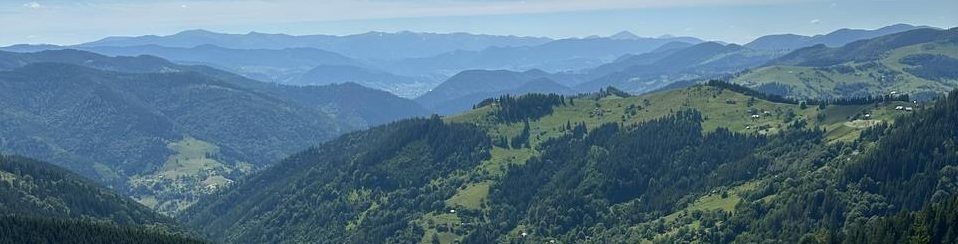
If you had told us years ago that we’d one day be sourcing Amanita mushrooms from the legendary Carpathian Mountains, we probably wouldn’t have believed you.
Yet here we are.
As an educational apothecary, we’re endlessly fascinated by where plants and fungi come from. Every landscape tells a story. Every ecosystem shapes the life growing within it.
And few places capture the imagination quite like the Carpathian Mountains.
Stretching across Eastern Europe, the Carpathians are home to some of the largest remaining old-growth and wild forests on Earth. Vast stands of spruce, fir, pine, and birch create the ideal environment for Amanita mushrooms to thrive naturally, just as they have for thousands of years.
The Carpathian Mountains offer clean air, abundant rainfall, rich forest ecosystems, and generations of traditional foraging knowledge. These forests remain relatively untouched compared to many heavily developed regions of the world, allowing Amanita to grow in the environment nature intended.
Our mushrooms are wild-foraged during peak season, carefully selected, and gently dried at low temperatures to preserve their natural characteristics.
One of the reasons we value these forests so deeply is because Amanita mushrooms cannot be farmed like most mushrooms.
Unlike Lion’s Mane, Oyster mushrooms, or Reishi, Amanita forms a living relationship with trees. Beneath the forest floor, its mycelium intertwines with the roots of spruce, pine, fir, and birch in a partnership known as mycorrhizae. The tree provides sugars produced through photosynthesis, while the fungus helps the tree access water and nutrients from the soil.
Without the forest, there is no Amanita.
This relationship is one reason Amanita has resisted large-scale cultivation. While many functional mushrooms can be grown indoors on sawdust or grain, Amanita depends on a thriving ecosystem and living tree partners to complete its life cycle.
That’s one reason the Carpathian Mountains have become so important to us.
These forests remain among the wildest and most ecologically rich landscapes in Europe. Walking through them feels like stepping into another world—one where nature still sets the pace.
For us, sourcing Carpathian Mountain Amanita isn’t simply about obtaining mushrooms.
It’s about honoring the forest they come from.
It’s about understanding the relationship between fungi, trees, soil, rain, season, and place.
Most of all, it’s about sharing that story with you.
Because every mushroom begins long before it reaches your hands.
It begins in the forest.
Did You Know?
The mushroom you see above the ground is only a small part of the organism.
The true body of the fungus exists underground as a vast network of mycelium. In healthy forests, these networks can connect multiple trees, moving water, nutrients, and chemical signals throughout the ecosystem.
Some researchers have even nicknamed these underground networks the “wood wide web.”
When an Amanita mushroom emerges from the forest floor, it’s the fruiting body of an organism that may have been living beneath the soil for years.
The next time you see an Amanita, consider what you’re actually looking at.
Not just a mushroom.
But the visible expression of an ancient partnership between fungi, trees, soil, water, and time—a relationship that has helped shape forests for millions of years.


You must be logged in to post a comment.