Posted on

Muscaria vs. Regalis vs. Pantherina: Understanding the Differences

If you’re new to the Amanita world, it can be hard to know where to start—or how each species differs. Muscaria, regalis, and pantherina may belong to the same genus, but they each carry entirely different energies and effects.

Here’s what you need to know—plus a look into how I experienced each one on my own journey.


🔴 Muscaria — The Gentle Teacher

Muscaria is where most people begin, and it’s often the most forgiving.

It’s supportive for the emotionally sensitive or energetically open. If you’re easing into nervous system repair, this is a solid ally.

At first, I didn’t feel much—until I realized the effects were cumulative. I needed higher amounts to notice anything dramatic, but that didn’t mean it wasn’t working. Muscaria was subtle, steady, and deeply nourishing when I gave it time.


👑 Regalis — Clear, Strong, Grounded

Eventually I moved into regalis, and it quickly became my favorite.

I loved its nutty, chocolatey aroma, but even more, I appreciated how it brought clarity, energy, and focus—but without overstimulation. I needed less than I did with muscaria to feel the same, or even stronger, effects.

At one point, I returned to regalis after a long pause and took my usual amount.
The result? It hit much harder than expected.
That’s when I realized what reverse tolerance really means—sometimes less is more.


🐆 Pantherina — Power with Purpose

My first experience with pantherina wasn’t pleasant. It made me feel aggressive, which I initially rejected. But over time, I realized that aggression was really internal resistance—I had reached a point where I needed to grow, push my body, and commit.

Once I started working out and caring for my vessel, pantherina became the mushroom that matched my pace. It now supports me when I need drive, movement, and sharper focus.

That said, it’s not for everyone. If your body is still learning to rest and regulate, pantherina can feel too intense.


💊 Form Matters Too

We offer three ways to work with muscaria, regalis, and pantherina. Each one suits different lifestyles and levels of readiness:

🍄 Dried Mushrooms

  • 35% naturally decarbed
  • Best for making your own slurry, extract, or capsules
  • Misfits are great for bulk DIY
  • Premium dried suits ceremony, art, or display

💡 Tip: Use a capsule machine (like Herb Affair) for clean DIY dosing.

💊 Microcapsules – 400mg each

  • Same 35% decarb as dried
  • Portable, precise, and easy to build into a routine
  • Effects vary depending on species and personal chemistry

Many find muscaria capsules calming.
Regalis micro can feel grounding and clear.
Pantherina micro may feel intense—best suited for those with higher metabolism or athletic output.

🧪 Slurry (Fully Decarbed)

  • Made using the 3-hour, 190°F, 2.8 pH method
  • Pure muscimol—no ibotenic acid left
  • Best for deeper rest, dreamwork, or emotional reset

Slurry – Fully decarbed for those short on time.


🧠 GABA, the Gut & Your Body’s Response

Amanita acts on the GABA-A receptors, which aren’t only in your brain—they’re also abundant in your gut nervous system.

That means people with gut sensitivities may experience GI activation, like cramping or loose stools. This doesn’t always mean something is wrong—it may reflect a nervous system response through your digestive pathways.

👉 Read our post on Amanita & Diarrhea to understand more about this connection.


🌀 Final Thoughts

Each Amanita species is a different kind of support.

  • Start with muscaria if you’re sensitive or new.
  • Try regalis when you’re ready for clarity without sedation.
  • Consider pantherina when you’re grounded, active, and aligned.

No matter which path you’re on, this work isn’t about effects—it’s about listening to your body, noticing shifts, and honoring the season you’re in.

📚Continue Reading

amanita vs psychedelics

What Makes Amanita Different from Psychedelics?

Read Next →


Posted on

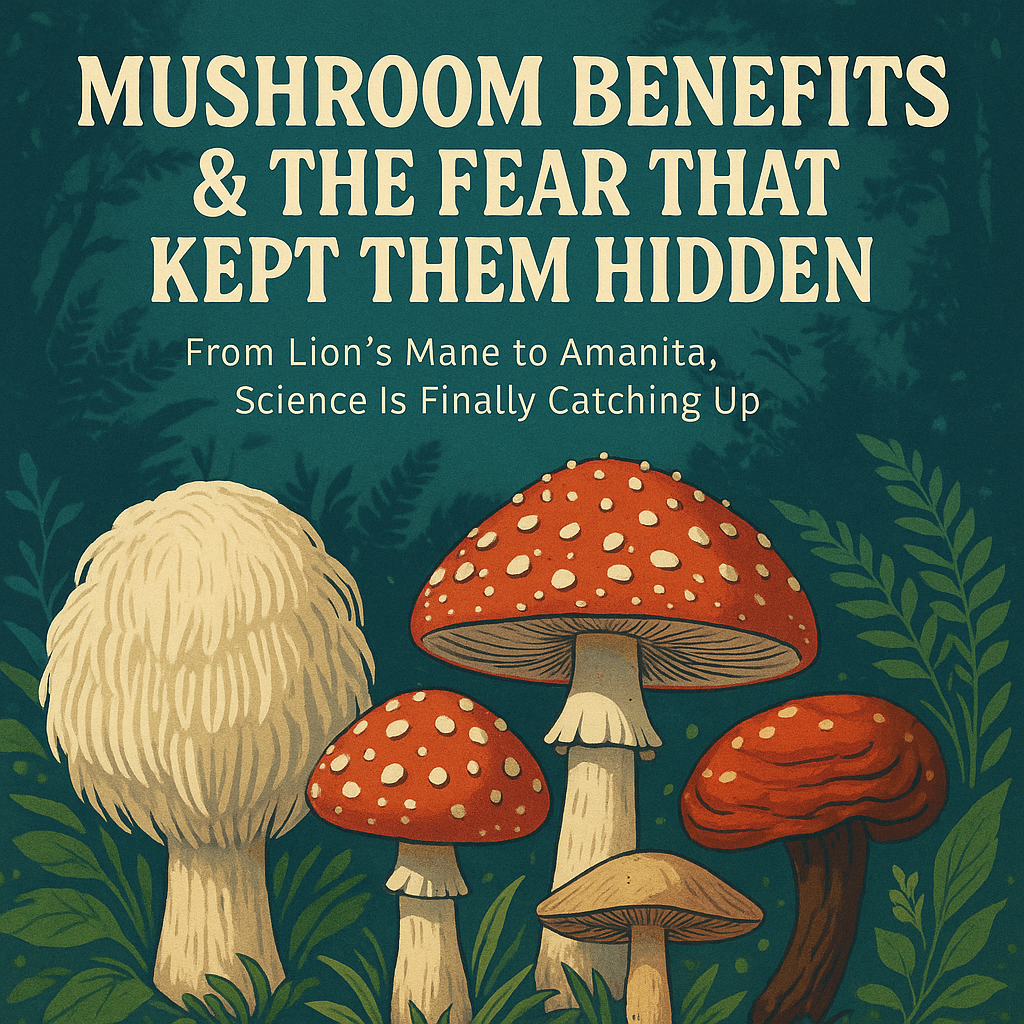
Why the Benefits of Mushrooms Were Hidden for So Long

From Lion’s Mane to Amanita, Science Is Finally Catching Up. Let’s discuss Mushroom Benefits.

Published by Awakening Roots – Think Beyond


Mushroom benefits are finally gaining mainstream attention, but their wisdom has always been here—quiet, powerful, and often misunderstood. From cognitive support to deep nervous system repair, mushrooms like Lion’s Mane, Reishi, and even Amanita offer profound insights into healing.

So why did we fear them for so long?
To answer that, we need to look at both science and history—and reclaim what’s been hidden beneath the forest floor.

If you’ve ever wondered what mushrooms really do—beyond food, fantasy, or folklore—you’re not alone. We live in a time of reconnection, and among the most overlooked allies in that process are fungi.

So let’s explore: What are the benefits of mushrooms?
And deeper still—why did we ever fear them in the first place?


🧠 Mushroom Benefits Backed by Science

There are over 14,000 identified mushroom species, and scientists estimate that over 2 million may exist globally. The following mushrooms are already backed by compelling clinical studies:

🦁 Lion’s Mane (Hericium erinaceus)

  • Stimulates nerve growth factor (NGF)
  • Supports memory, cognition, and brain repair
  • Shown to reduce mild anxiety and improve focus

🛡️ Reishi (Ganoderma lucidum)

  • Calms the nervous system
  • Supports immune balance and inflammation response
  • Long revered as a spiritual tonic in Eastern traditions

⚡ Cordyceps (Cordyceps militaris)

  • Boosts cellular energy (ATP)
  • Improves oxygen utilization and stamina
  • Used in traditional Chinese medicine for fatigue and aging

🌿 Turkey Tail (Trametes versicolor)

  • Rich in polysaccharide-K (PSK) with anti-tumor activity
  • Used alongside chemo in Japan to modulate immunity
  • Supports gut flora and digestion

🧬 Chaga (Inonotus obliquus)

  • High in melanin, antioxidants, and betulinic acid
  • Anti-inflammatory and liver-protective
  • May support skin, immunity, and oxidative stress balance

👁️ Why Do We Fear Mushrooms?

Despite these benefits, mushrooms have long been culturally feared—especially in the West. Here’s why:

⚠️ 1. Evolutionary Protection

Mushrooms don’t all taste good, and many look unfamiliar. Historically, some were fatal. Our ancestors evolved a “better safe than sorry” bias. The result?
→ A biological aversion to unfamiliar fungi.

🔥 2. Witch Trials & Church Persecution

In medieval Europe, mushrooms—especially visionary ones—were tied to paganism and witchcraft. Healers who used them were often executed.
→ Generational trauma and cultural suppression of mushroom knowledge followed.

❌ 3. Scientific Neglect

For most of modern history, fungi were ignored in textbooks, underfunded in research, and omitted from health protocols.
→ Leading to misinformation, misidentification, and missed opportunities.

🪞 4. Symbol of the Unknown

Mushrooms emerge from decay, thrive underground, and appear overnight. They challenge our need to control and categorize.
→ To fear mushrooms is often to fear what we don’t understand within ourselves.


🍄 Amanita Deserves a Seat at the Table

While the world embraces psilocybin, Amanita muscaria, regalis, and pantherina are still largely misunderstood. But they are equally deserving of attention.

Why?

  • They don’t act on serotonin—they work through GABA and glutamate
  • They are not classified as hallucinogens
  • They’ve been used in Siberian, Nordic, and Baltic traditions for centuries
  • Modern science is now validating their muscimol-based effects for calm, sleep, and nervous system recalibration

Unlike other mushrooms, Amanita doesn’t “amp you up.”
It grounds, depatterns, and often gently reflects what needs to be seen.


🔄 Integration Is Everything

Mushrooms are not one-size-fits-all. What works for one nervous system may not work for another.

We’ve seen:

  • People who prefer microcapsules for clarity and focus
  • Others who rely on slurry for emotional reset or rest
  • Some who combine Lion’s Mane with Amanita for a potent synergy of nerve support

Understanding your biology, tracking your response, and approaching these tools with reverence—not dogma—is what opens the door to transformation.


🌱 Final Thoughts: The Kingdom Beneath Our Feet

Mushrooms are not here to “cure” you.
They’re here to partner with you.
To awaken what’s been dormant.

So yes—ask what the benefits are.
But also ask: Why were we ever told not to look here?

The answer might say more about the system than the spores.

Posted on

🌍 Where Do Amanita Mushrooms Grow?

Where do Amanita mushrooms grow?

Have you ever wondered, where do Amanita mushrooms grow, can’t I just grow them myself? Well let’s dive into the answers you seek about Tree Partnerships, Global Zones, and Why You Can’t Just Grow Them


Most mushrooms can be cultivated in sterile labs or grow kits. Amanita mushrooms are wild, relational, and deeply connected to the ecosystems they thrive in.

To understand their power, you must understand their place. Because where Amanita mushrooms grow tells you everything about their potency, safety, and spirit.


🌲 Why You Can’t Grow Amanita Mushrooms

Amanitas are mycorrhizal mushrooms, meaning they grow in symbiotic partnership with trees. They form underground relationships with the root systems of specific species, exchanging nutrients and signaling forest health.

Unlike functional mushrooms like Lion’s Mane or Cordyceps, you cannot cultivate Amanita muscaria, regalis, or pantherina in labs, tubs, or bags. Their very existence depends on:

  • The right tree host
  • Unpolluted soil
  • Undisturbed forest networks

They most commonly grow under:

  • Birch
  • Pine
  • Spruce
  • Fir

This is why Amanita is considered wildcrafted—never farmed. It must be respectfully foraged, never manufactured.


🌎 Where Do Amanita Mushrooms Grow Around the World?

Amanita mushrooms grow across Europe, Asia, North and South America, Australia, and parts of Africa. They are one of the most widespread mushroom genera on Earth, with fruiting seasons typically in late summer to early fall.

You’ll often find them in:

  • Temperate forests
  • High elevation mountain zones
  • Mossy, shaded clearings rich in tree diversity

Environmental factors like altitudetree partner, and climate can impact their color, cap size, and chemical ratios (muscimol vs. ibotenic acid).


🍄 Amanita Species We Work With

There are over 600 species in the Amanita genus.
We work with three safe, distinguishable species:

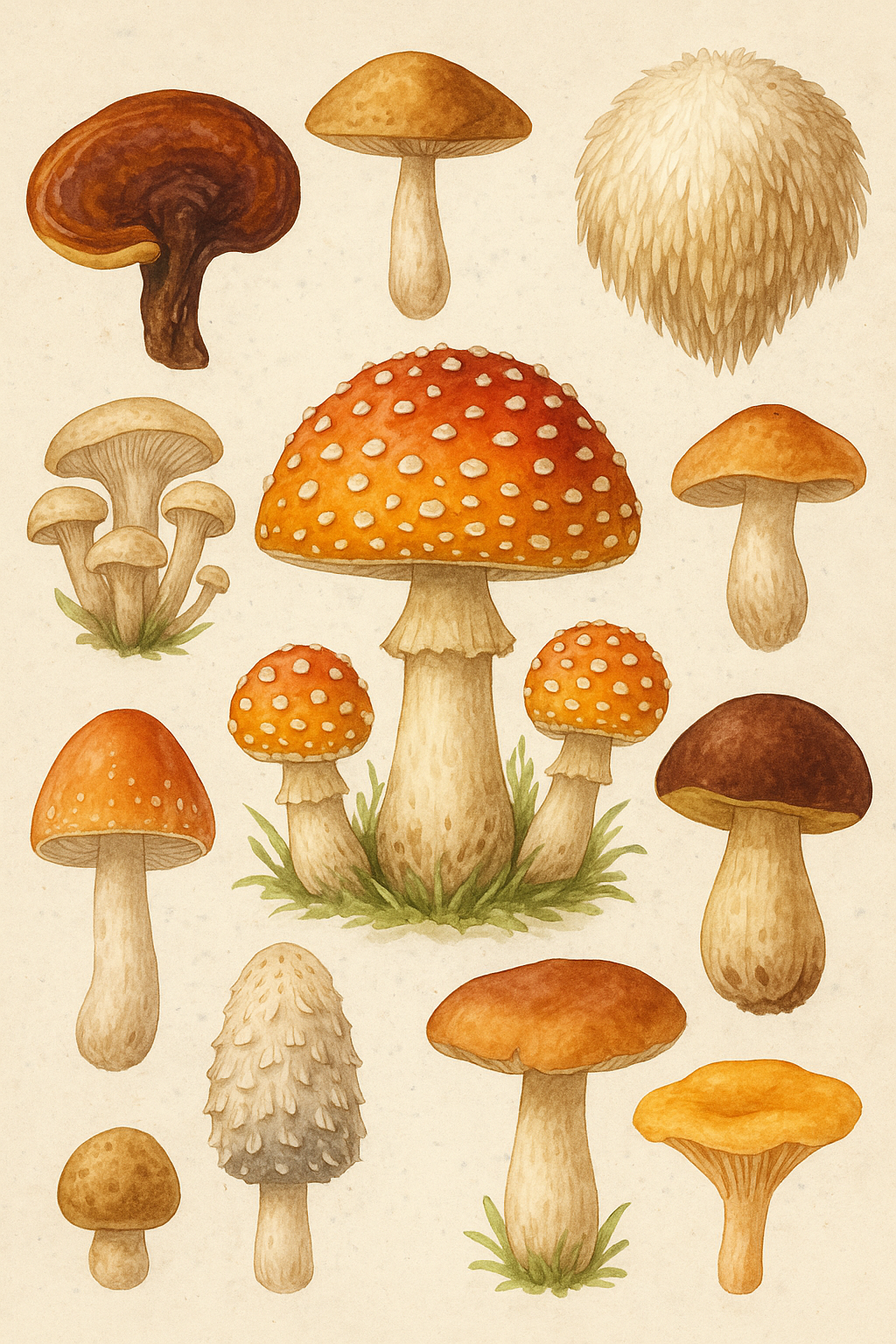
  1. Amanita muscaria – Iconic red cap, white warts, mildest potency
  2. Amanita regalis – “The Royal Fly Agaric,” rich brown tones, earthy energy
  3. Amanita pantherina – Tan cap, highest muscimol concentration, most potent

Each has a unique balance of ibotenic acid (excitatory) and muscimol (GABAergic), and each behaves differently in the body.


❗ Why Was Amanita Classified as a Poison?

Much of the fear around Amanita stems from toxic lookalikes in the same genus—particularly:

  • Death Cap (Amanita phalloides)
  • Destroying Angel (A. virosaA. bisporigeraA. ocreata)

These species contain amatoxins, compounds that attack the liver and kidneys. They’re responsible for most fatal mushroom poisonings worldwide.

However, the Amanita species we work with—muscaria, regalis, and pantherina—do not contain amatoxins. They are chemically and visually distinct.

Here’s how they differ:

SpeciesCapWartsToxinsSafety
MuscariaBright redWhiteIbotenic acid / muscimolNon-lethal, traditional
RegalisChestnutWhiteSamePotent but safe
PantherinaTanWhiteSameStrongest, requires respect
Death CapPale greenSmoothAmatoxinsFatal
Destroying AngelWhiteSmoothAmatoxinsFatal

They are not easily mistaken if basic identification practices are followed.


❌ Why Not Forage Amanita in the U.S.?

Though Amanita muscaria is found throughout North America, foraging in the U.S. comes with risks:

  • Higher ibotenic acid content in some regions
  • Premature harvesting lowers therapeutic potential
  • Environmental toxins from roadways, pesticides, and air pollution
  • Misidentification risks without deep mycology knowledge

We’ve personally seen variation in purity and potency from U.S.-foraged mushrooms, and this inconsistency is why we don’t rely on domestic sources.


🏔️ Why We Source from the Carpathian Mountains

All our Amanita mushrooms—muscaria, regalis, and pantherina—are foraged in the Carpathian Mountain ranges of Ukraine.

We chose this region for its:

  • Rich birch and pine forests
  • Low pollution, clean air, and deep soil
  • Generational foragers who understand these species
  • Consistent seasonal potency and full maturity

This allows us to offer clean, ethically sourced mushrooms that honor both tradition and the nervous system.


🧬 Final Thoughts: Where Do Amanita Mushrooms Grow?

They grow in the wild.
In partnership with trees.
In ecosystems still whole.

You cannot grow them. You must meet them.

And the place they grow matters as much as how they’re used.
So when asking, where do Amanita mushrooms grow?—the deeper truth is:
They grow in relationship, and only where the earth still remembers how.


📚📚Continue Reading

Posted on Leave a comment

🧬How to Take Amanita:

🍄 How to Take Amanita: Why One Month Makes All the Difference

Science-Based Guidance for Nervous System Support & Functional Healing


If you’re wondering how to take Amanita, you’re not alone.
Whether you’re drawn to its dreamwork potential, its ability to support nervous system regulation, or the curiosity it sparks across spiritual and scientific spaces—Amanita is unlike any other mushroom.

It’s not a serotonin psychedelic.
It doesn’t create visuals or euphoria.
Instead, it works by supporting GABA-A receptors—a critical pathway in your body’s natural braking system.

But to see real transformation, a single dose won’t cut it.
This is a mushroom that responds to rhythm, not intensity.
And that’s why we recommend a minimum 1-month protocol when beginning your journey.


🧠 The Science of GABA and Muscimol

The primary active compound in Amanita, muscimol, is a known GABA-A receptor agonist. GABA is the body’s main inhibitory neurotransmitter, responsible for:

  • Reducing overstimulation
  • Supporting deep sleep and dream cycles
  • Lowering physical and emotional reactivity
  • Calming racing thoughts

Chronic stress, cannabis or alcohol use, trauma, and digital overstimulation can lead to GABA depletion, leaving us stuck in fight-or-flight loops, insomnia, and emotional flatness.

How to take Amanita for nervous system healing?
Through low, consistent use over time—not by chasing peak experiences.


🍄 Amanita Isn’t Just One Thing

Here’s what many first-time users get wrong:
Amanita doesn’t always feel sedating or restful.
For some, it provides gentle clarity, emotional uplift, and focus.
For others, it induces sleep, helps them unwind, or reconnects them to their body.

Some find microcapsules subtly energizing, while others feel drowsy.
Some experience slurry as activating; others find it grounding.

In fact, many report a two-phase effect:
A window of clarity and motivation, followed by calm sleep.

This variation comes down to biology:
➡️ Liver enzyme pathways
➡️ Receptor density
➡️ Food intake
➡️ Metabolism
➡️ Emotional state

This is why we do not prescribe a specific dose or schedule.
Instead, we suggest:

  • Start with one form (micro or slurry)
  • Track how it affects your body and mind
  • Remain consistent 2–4 days per week
  • Wait a full month before deciding to adjust or taper

🌿 How to Take Amanita Alongside Other Mushrooms

Functional mushrooms like Lion’s Mane and Reishi are often stacked alongside Amanita for deeper synergy.

Lion’s Mane promotes nerve growth factor (NGF) and supports memory, clarity, and neuron regeneration.
Paired with Amanita’s GABAergic support, you get both:

  • Cognitive rebuilding (Lion’s Mane)
  • Nervous system regulation (Amanita)

This combo is ideal for people recovering from:

  • Cannabis dependence
  • Burnout or emotional numbness
  • Trauma-related freeze states
  • Sleep disruptions or memory fog

How to take Amanita and Lion’s Mane together?
Alternate them throughout the week—or combine in small doses.
Always observe your system. Less is often more.


🗓 Why One Month?

Based on thousands of user reports and years of internal observation:

  • Week 1: Fatigue may surface; the body begins slowing down
  • Week 2: Emotions rise, dreams return
  • Week 3: Nervous system steadies; less reactivity
  • Week 4: Subtle shifts lock in—better sleep, presence, clarity

After a month, many users choose to:

  • Continue at a reduced pace
  • Taper, noticing that less becomes more
  • Or pause, trusting that the work has been integrated

This is supported by what’s known as reverse tolerance:
With Amanita, your body becomes more sensitive over time—needing less to feel more.


🧬 Final Thoughts

If you’re asking how to take Amanita the right way—the answer is:
With consistency, self-tracking, and patience.

This is not about tripping, escaping, or forcing insight.
It’s about letting your nervous system remember what safety feels like—and giving it the space to rebuild.


Posted on Leave a comment

Why Amanita Doesn’t Work for Everyone

Amanita doesn't work

🍄 Amanita Doesn’t Work? Why Not Feeling Anything Might Mean It’s Working Better Than You Think

Many people try Amanita mushrooms for the first time—especially through microdosing capsules—and wonder: “Why don’t I feel anything?”

It’s a fair question. In a world conditioned by instant results, extreme sensations, and emotional spikes, the subtle medicine of Amanita can feel almost invisible. But invisibility does not mean inactivity. In fact, it might be a sign that the real work is happening beneath the surface.


🌿 Microdoses Are Not Meant to Feel Loud

Microcapsules support your body’s natural systems, especially the GABAergic system—helping regulate anxiety, sleep, focus, and emotional balance.
They’re not designed to send you on a trip.
Nor alter your day.
But they are designed to stabilize your internal world, not distort it.

The goal isn’t to feel different.
The goal is to become more yourself.


🔥 Moderate Doses Are Where Sensations Begin

If you are seeking a more noticeable connection—dreaminess, relaxation, increased lucidity—this typically happens at moderate, intentional doses of Amanita preparations (like properly made slurry).
But caution must lead the way.
This path is sacred, not recreational.


⚠️ Why High Doses Are NOT Encouraged

Pushing into shamanic-level high doses without preparation and guidance is not safe.

Potential risks include:

  • Loss of motor control or calibration
  • Twitching and muscle spasms
  • Strong disconnection from linear time
  • Unpredictable bodily responses

The medicine doesn’t fail.
We fail when we expect it to behave like substances of escapism.

Amanita’s highest calling is integration—not escape.


🧠 A New Way to Measure Progress

Instead of asking:
“Do I feel high?”

Start asking:

  • Am I sleeping better?
  • Is my anxiety lower?
  • Am I responding to life more calmly?
  • Do I feel slightly more grounded day after day?

This is Amanita at work.

Subtle, sacred, steady.


🌔 Final Word about stating Amanita doesn’t work?

If you’re not feeling fireworks, congratulations:
You’re not supposed to.
You’re stepping into healing through harmony, not intensity.

And if you’re ready for personalized guidance on how to integrate Amanita into your life, explore our Think Beyond Consulting sessions for deeper support.

🌿 Trust the quiet work. That’s where the real magic happens.

Check out our YOUTUBE channel where we come alive with educating you to Awaken to your Roots.

Posted on Leave a comment

💩 Amanita Diarrhea: Is it Normal?

💩 Amanita Diarrhea: Is it Normal?

💩 Amanita Diarrhea: What’s Normal, What’s Healing, and What You Should Know

Let’s talk about something no one wants to talk about: Amanita mushroom diarrhea. Uncomfortable? Yes. Embarrassing? Maybe. But when it comes to Amanita mushrooms, it might be more normal than you think.

It’s not uncommon to hear that Amanita slurry can lead to sudden bowel movements. I’ve experienced this myself and found it to be a powerful release rather than something to fear.

🧠 Amanita Diarrhea and the Gut Connection

As someone who has been diagnosed with IBS and has had my gallbladder removed, I can tell you firsthand that Amanita activates my digestive system in a powerful way. But here’s the key—it’s not a side effect; it’s a signal.

Gut biome health is everything. If your gut is inflamed, unbalanced, or toxic from years of processed food, poor digestion, or antibiotic overuse, then taking Amanita—especially in slurry form—can feel like a gut reboot. It wakes the system up and starts the process of elimination. In some cases, that elimination is literal.

Compare that to my husband, who has a perfectly balanced digestive system. No gut issues. No IBS. And guess what? No bowel urgency when taking Amanita. That contrast alone confirms the role of individual gut health in how the mushroom is received.

🌿 Why Amanita Diarrhea May Be a Digestive Ally

Let’s take a look at the possible reasons why Amanita can activate the bowels:

  • Muscimol interacts with GABA receptors, which are also found in the gut. The gut-brain connection is real. Studies show GABA plays a direct role in gastrointestinal motility and visceral sensitivity.
  • The bitter taste and acidic properties of a properly prepared slurry may stimulate digestive enzymes. Bitter herbs are well-known to enhance digestion by increasing bile flow and enzyme production.
  • Amanita may act as a mild purgative, helping the body clear excess mucus, bile, or backed-up waste. This concept of plant-based purgation has roots in many traditional healing systems.
  • Inflammation modulation: If you suffer from chronic inflammation, Amanita may trigger a release or shift in the digestive tract. Muscimol has shown some neuroprotective and anti-inflammatory properties in animal models (source).

🧬 The Gut Biome Is the Gatekeeper — And Your Intuitive Center

We are learning more every day about how the gut is not just a digestive organ, but also our intuitive center—the place ancient wisdom traditions refer to as the second brain. Modern science now supports what mystics and healers have always known: that intuition often speaks through the gut. In fact, over 90% of serotonin—the neurotransmitter associated with mood and perception—is produced in the gut, and the enteric nervous system has its own complex signaling system independent from the brain (source). If your microbiome is imbalanced, anything with activating energy—be it fermented food, herbal medicine, or mushrooms—can create a temporary clearing reaction.

Research published in Nature Microbiology confirms the gut-brain axis plays a critical role in neurochemical signaling, meaning your body’s reaction to natural compounds is deeply personal.

Is it uncomfortable? Sometimes. But is it dangerous? In the case of Amanita, and assuming you’re working with safe preparation and proper guidance—likely not.

🔍 Seek the Root, Not Just Relief

If Amanita gives you the runs, it’s time to get curious—not fearful. Ask yourself:

  • What am I holding onto in my body?
  • How’s my gut health really?
  • Is this discomfort clearing the path for deeper wellness?

Support your body through it. Hydrate. Rest. Eat simply. Trust that the body is intelligent.

💡 Final Thoughts on Amanita Diarrhea and Purging as Healing

Diarrhea isn’t always a sign something is wrong. Sometimes, it’s a sign something is finally moving out. With Amanita, whether mushroom, pantherina, or regalis, your experience may vary based on your current gut health. Don’t be alarmed—be aware.

Spiritual healers across cultures have long regarded purging as a form of release—a cleansing of energetic, emotional, and physical blockages. From sweat lodges to plant medicine rituals, the body’s urge to eliminate has always been seen as sacred. Even modern science now speaks to the detoxification benefits of brief, self-limiting purging cycles. But in our current society, we’ve been conditioned to view any sign of elimination—like diarrhea—as gross or problematic.

The truth? This is often where the real healing begins.

Of course, if you’re experiencing excessive or prolonged purging that lasts more than a few days, it’s wise to consult with a trusted health professional. But for most, Amanita-related purging is a temporary signal from the body—an invitation to release what no longer serves.

🌕 Trust your gut. Trust the process. Let what no longer serves you… go.


🧪 Hydration Elixir Recipe for Gut Recovery

If you’ve experienced digestive clearing after Amanita, it’s important to rehydrate and replenish. Here’s a simple elixir designed to support your gut, nervous system, and energy:

🌿 Ingredients:

  • 12–16 oz warm spring or filtered water
  • 1/4 tsp Celtic sea salt or pink Himalayan salt (electrolyte support)
  • 1 tsp raw honey or organic maple syrup (for trace minerals & energy)
  • 1 tbsp fresh aloe vera gel (optional, soothing to the gut lining)
  • Juice of 1/2 a lemon (alkalizing & bile supportive)
  • Pinch of organic ginger powder (optional, for digestion)

✨ Instructions:

  1. Mix all ingredients in a glass jar or shaker bottle.
  2. Sip slowly on an empty stomach, ideally after a clearing bowel movement or in the morning.
  3. Repeat once or twice throughout the day as needed.

This elixir is not just for hydration—it’s for restoring gut harmony and reconnecting with your center. Your body is brilliant. Help it find its balance.**

📚Continue Reading

All Natural Products

Amanita is one path—but it is part of a much larger conversation about personal growth. Explore what makes Amanita unique among natural tools and why lasting transformation always begins with the relationship you build with yourself.

➡️ Read next: Natural Tools for Inner Growth: Why Amanita Stands Apart

“Browse every article by topic.”

Explore our Library →

Posted on Leave a comment

🔥 Decarboxylation of Amanita: Why It Matters

In this post we will discuss decarboxylation of amanita mushrooms : Why It Matters and How to Do It Right

The word might sound complicated, but decarboxylation is one of the most important steps in working with Amanita muscaria, Amanita pantherina, or Amanita regalis. Without it, you’re not accessing the true potential of the mushroom—you’re just chewing on ancient history without unlocking its modern magic. In this post, we’ll break it down step by step and explain why this process matters not just scientifically, but spiritually too.

🍄 What Is Decarboxylation?

In simple terms, decarboxylation is the process that transforms ibotenic acid into muscimol—the active compound responsible for Amanita’s calming, lucid, dreamlike effects. This transformation happens through heat and time. Ibotenic acid is naturally present in raw Amanita but can cause discomfort if consumed directly. Muscimol, however, is a more refined and spiritually grounded molecule that interacts with the GABA system, promoting relaxation and introspection.

Why does this matter? Because the experience you’re seeking—whether it’s clarity, deep rest, or reconnection with Source—comes through muscimol, not ibotenic acid.

🔬 The Science Behind It

Here’s how it works:

  • Ibotenic acid (C5H6N2O4) is unstable under heat.
  • When heated (gently and over time), it loses a carboxyl group (COOH).
  • This converts it into muscimol (C4H6N2O2), the compound aligned with Amanita’s healing potential.

This process is backed by lab testing and years of ethnomycological observation. Without decarbing, your body does part of this transformation naturally—but slowly and often with digestive upset.

Want to go deeper? Explore our Amanita FAQ and Amanita Muscaria vs. Psychedelics.

🔥 How to Decarb Amanita Mushrooms Correctly

If you’re working with fresh foraged Amanita mushrooms, proper preparation is key. Here’s how to decarb the natural way:

🌬️ Air Drying Method (From Raw)

  1. Start with clean, whole Amanita caps.
  2. Use a dehydrator or drying rack to maintain a steady temperature between 90–115°F (32–46°C).
  3. Dry until cracker-dry—this usually takes 24–48 hours depending on your climate.
  4. This method results in a natural 35% decarb, enough for some users to work with the mushroom as-is.

From here, you have two options:

💧 Simmer Method (Alkaloid Transfer Only)

  • Add dried caps to water and gently simmer (not boil) for 30 minutes.
  • This transfers the alkaloids from the mushroom into the water.
  • ⚠️ Note: This method does not significantly decarb the material. It is for extraction, not transformation.

🔄 Slurry Method (Full Decarb)

  • For those who want a more complete transformation, we use the slurry method:
    • Simmer dried caps in water at 190°F (88°C) for 3 hours.
    • Adjust the water to a pH of 2.8 using citric acid (lemon juice or ACV can make it unpleasant).
    • Strain, cool, and store.
    • This results in what is considered a full decarb, though complete conversion would require a laboratory environment.

This is the method used for our proprietary Amanita slurries.

🌿 Why Decarb Is More Than Just Science

At Awakening Roots, we don’t just decarb for effect—we do it with intention. The transformation of ibotenic acid into muscimol mirrors our own journey: raw, chaotic energy becoming grounded, wise, and clear. We believe preparation is a sacred act, not just a step in production.

🧠 Final Thoughts

When it comes to decarboxylation of Amanita mushrooms, intention and preparation are everything. Decarboxylation ensures you’re connecting with the mushroom’s full potential—gently, safely, and powerfully. Don’t skip this step. Honor it.

🌕 Think beyond the raw. Activate the sacred.

📚Continue Reading

how to decarb amanita

Ready to put this knowledge into practice?

Now that you understand why decarboxylation matters, learn the step-by-step process for preparing Amanita correctly.

➡️ Read next: How to Decarboxylate Amanita Mushrooms

“Browse every article by topic.”

Explore our Library →

Posted on Leave a comment

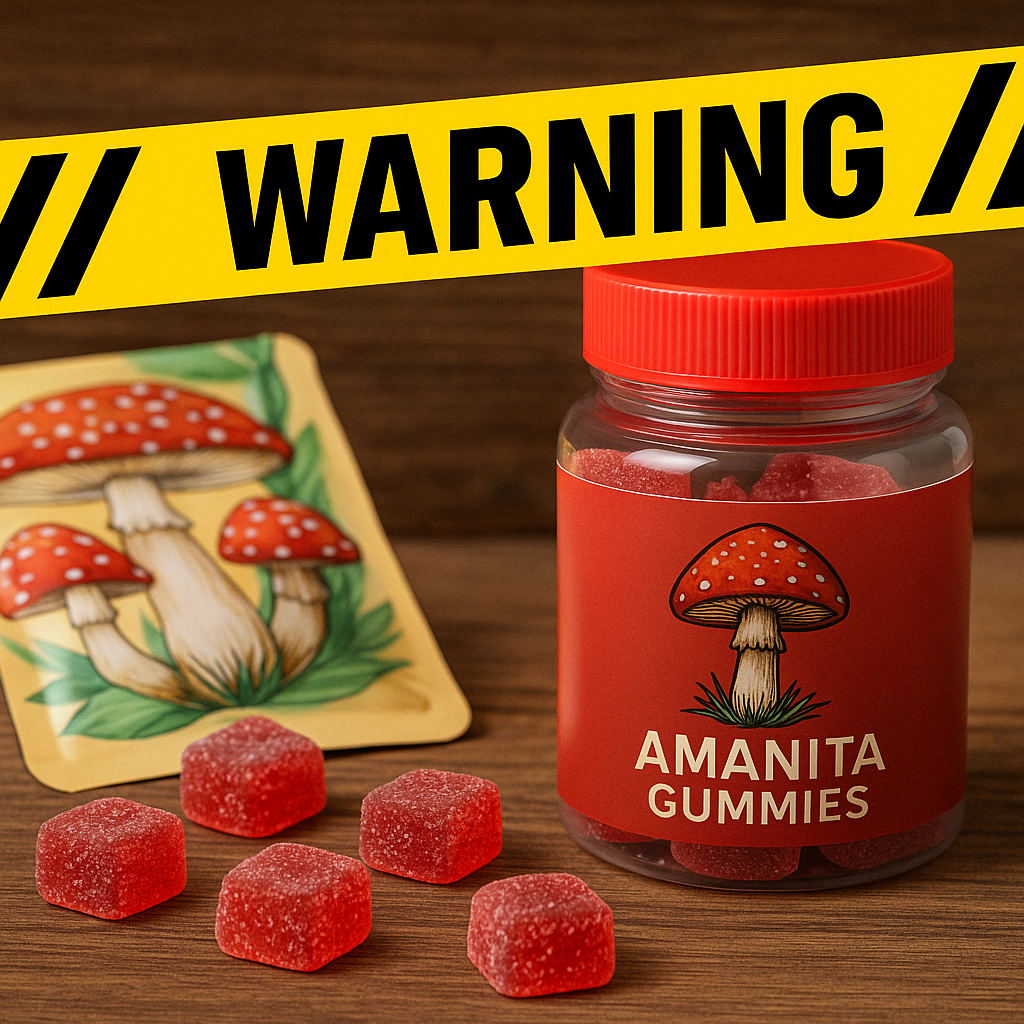
🍄 Fake Amanita Gummies – Hidden Dangers You Must Know

As interest in mushrooms grows, so does the flood of products hitting store shelves—from beautifully crafted tinctures to colorful gummies and chocolates. But not everything that sparkles is safe. The rising trend of fake Amanita gummies sold at gas stations and smoke shops is misleading and potentially harmful.

These products may seem like a fun, easy way to try mushroom benefits. But under the flashy labels and fruity flavors lies a serious problem: many of these so-called “Amanita” gummies don’t contain Amanita muscaria. Instead, they use unscheduled synthetic compounds—research chemicals—that haven’t been properly tested. Worse, they lack the spiritual energy and depth that real Amanita carries.

🧪 What Are These Fake Amanita Gummies Really Made Of?

Most of these products use synthetic analogs that mimic psilocybin or DMT. Because they aren’t officially regulated, they slip through legal cracks and end up mass-produced. Common ingredients include:

  • 🧬 Research chemicals (e.g., 4-AcO-DMT, 5-MeO-DALT)
  • 🧁 Artificial dyes like Red 40, Yellow 5, and Blue 1, linked to behavioral issues and allergic reactions
  • 🍬 High-fructose corn syrup and refined sugars, which harm brain health, gut health, and blood sugar balance
  • 🧫 Artificial flavors and preservatives, which can cause inflammation, hormone disruption, and long-term health issues

These ingredients disconnect us from nature and give people a false understanding of sacred mushroom medicine.

🌲 Real Amanita Muscaria: A Sacred Experience, Not a Shortcut

Amanita muscaria is not a psychedelic in the typical sense. Its main compounds—muscimol and ibotenic acid—affect the GABA system, leading to a calming, dreamy state. When decarboxylated, muscimol becomes dominant, offering a safe and ancient experience when used with care.

✨ Muscimol has a long tradition of use in Siberian, Scandinavian, and Indigenous cultures. People respected this mushroom. They prepared it carefully and used it in sacred rites. Reducing it to a sugary snack with cartoon branding strips it of meaning and turns ancestral wisdom into a gimmick.

🔻 Fake Gummies Disconnect You From Nature and Spirit

Consuming products packed with sugar, dyes, and artificial compounds throws us off balance. These toxins disrupt the gut-brain connection and cloud the pineal gland—our spiritual antenna. Over time, they build up and create a fog that blocks inner clarity and connection to Source.

This distortion is the opposite of what true mushroom allies are here to do. Learn more about Amanita Muscaria vs. Psychedelics.

🕵️‍♀️ How to Tell If It’s a Real Amanita Product

  1. 🏷️ Read the label: Look for Amanita muscaria, regalis, or pantherina.
  2. 🔍 Know the vendor: Are they educating or just selling?
  3. 📦 Watch the packaging: Flashy designs often signal mass production, not tradition.
  4. Ask the right questions: Can they explain decarboxylation, sourcing, and proper use?

🧭 A Final Word on Fake Amanita Gummies: Choose Mindfully

In a world where profit often outweighs purpose, we must choose mindfully. Real mushrooms guide us toward growth—not just a feeling. Let’s honor their wisdom. Let’s not trade ancient power for artificial highs.

🌿 Think beyond the packaging. Return to the root.

Check out our YOUTUBE channel where we come alive with educating you to Awaken to your Roots.

Posted on 2 Comments

🌬 Amanita and the Freeze Response

Dissociation or Deep Return? Understanding Trauma, GABA, and the Sacred Role of Muscimol in Amanita and the freeze response

Published by Awakening Roots – Think Beyond

“You are not broken—you are paused. And the mushroom doesn’t push. It invites.”

For many walking the path of trauma recovery, the buzzwords are often “fight or flight.” But there’s a third response that hides in plain sight—and affects far more of us than we realize:

Freeze.

This post—Amanita and the Freeze Response—dives into how Amanita muscaria may support those who live in a state of emotional, physical, or energetic shutdown. And we’ll also clear up a common misconception:

Is Amanita a dissociative or a healing ally?

Let’s explore the science and the soul.


❄️ What Is the Freeze Response?

Freeze is what happens when the body says:

“I can’t fight. I can’t run. So I’ll play dead—maybe it’ll be safe later.”

It’s not weakness. It’s survival.

The freeze state often shows up as:

  • Chronic fatigue
  • Emotional numbness or indifference
  • Shutdown in response to stress
  • Inability to make decisions or take action
  • Feeling “disconnected” from your own life or body

This is not a mindset issue. It’s nervous system patterning—often from unprocessed trauma.


🌿 How Amanita May Help Unfreeze the System

Unlike serotonin psychedelics or cannabis, Amanita doesn’t stimulate or escape.

It works through the GABA-A receptor system—the body’s rest-and-restore network.

Muscimol (the active compound in fully decarboxylated Amanita) supports:

  • Parasympathetic regulation (aka: relaxation and safety)
  • Sleep cycle recalibration
  • Dream return (REM restoration)
  • Slow, rhythmic nervous system repair
  • Emotional accessibility without overstimulation

Rather than “activating” the freeze, Amanita may gently help unwind it.

“It gives the system permission to thaw—not explode.”


🌀 But Wait—Isn’t Amanita a Dissociative?

This is where it gets nuanced—and where so many guides and sources miss the mark.

Yes, Amanita can create dissociation—but only under certain conditions:

  • High doses, especially of ibotenic acid-rich material
  • Raw caps that haven’t been properly decarboxylated
  • Pantherina used without guidance
  • People with extreme trauma being overstimulated

That’s where the “deliriant/dissociative” label comes from.

However—at low to moderate, fully decarboxylated doses, like in our Slurrys, Amanita does not push you away from yourself. It does the opposite.

It brings you home to the body—gently, patiently, and with no rush.

This isn’t speculation—it’s based on years of personal experience and community feedback.


⚖️ Amanita vs Traditional Dissociatives

SubstanceEffect ProfileRisk of DependenceNervous System Support?
Cannabis (high dose)Emotional detachment, dream lossYesCan mask dysregulation
KetamineNumbing, ego-blasting, clinical useYesTemporary dissociation
BenzodiazepinesPanic suppression, sedationYesArtificial GABA mimicry
Amanita (low dose)Stillness, emotional awareness, dream returnNoYes — GABA supportive

🌱 Who Might Benefit?

Amanita may support those who:

  • Struggle to feel or express emotions
  • Can’t seem to “get going”
  • Are caught in freeze/shutdown cycles
  • Are healing from nervous system burnout or spiritual dissociation
  • Want to return to dreaming and sacred sleep

It’s not about “doing more.”
It’s about being safe enough to be here again.


🌕 Final Thoughts

Amanita is not a psychedelic. It’s not a dissociative.
Nor is it here to blast you into the stars.
Rather It’s here to soften the ice—so you can hear yourself again.

“The freeze protected you. The mushroom reminds you you’re safe now.”

You don’t need to fight or flee anymore.
There’s another path. And it begins with stillness.


Check out our YOUTUBE channel where we come alive with educating you to Awaken to your Roots.

Posted on 2 Comments

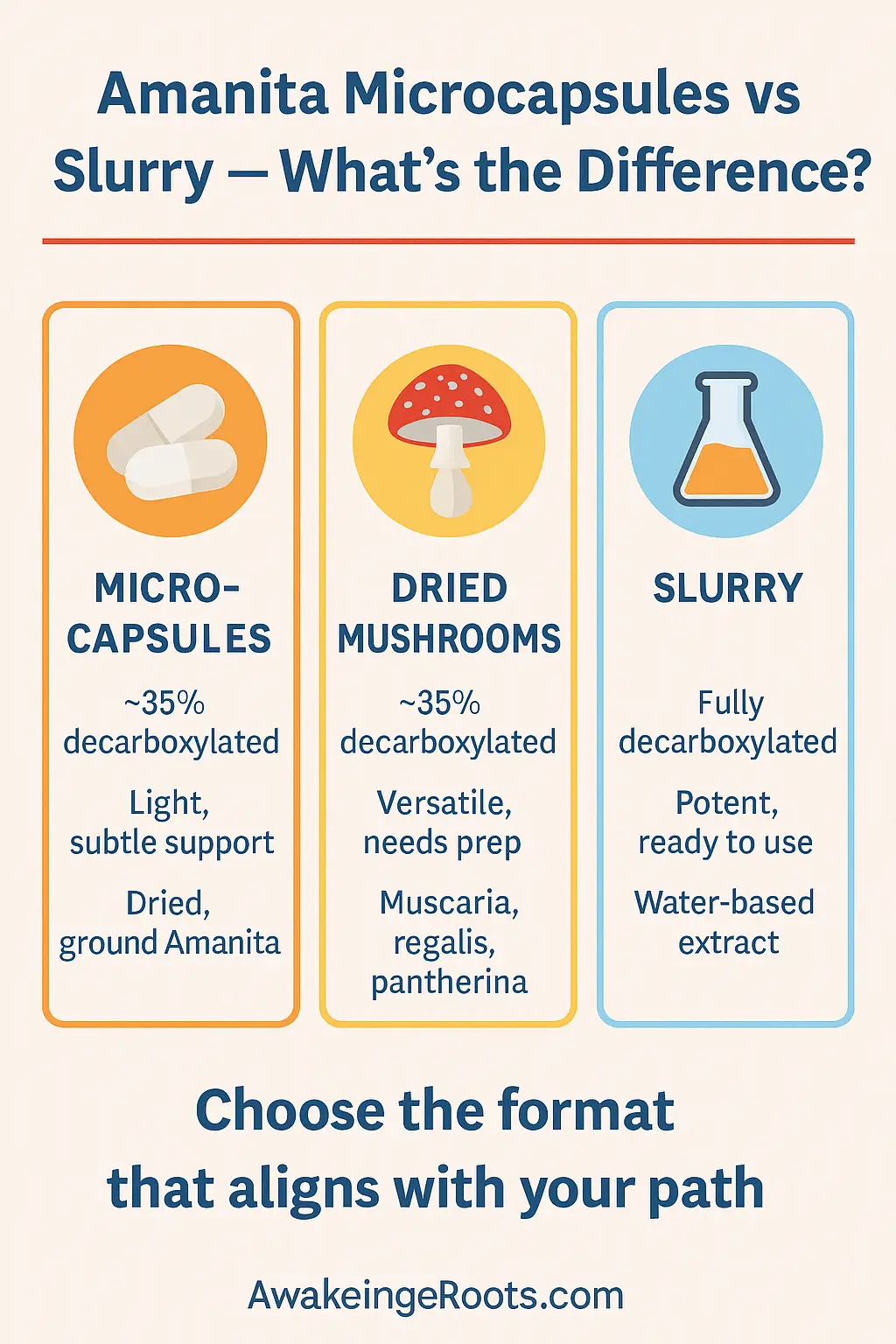
🍄 Amanita Microcapsules vs Slurry – What’s the Difference & How to Choose

Amanita microcapsules vs Slurry

Amanita Microcapsules vs Dried mushrooms vs Slurry – What’s the Difference & How to Choose | Awakening Roots

“Different tools. Different purposes. One sacred mushroom.”

In the growing world of legal Amanita offerings, many seekers are left wondering:

What’s the difference between microcapsules, dried caps, and slurry—and which one is right for me?

This post—Amanita Microcapsules vs Slurry vs Dried Mushrooms—was created to bring clarity to that very question. Each format is unique in its chemistry, energy, and purpose. Understanding these differences is key to approaching this sacred mushroom with intention, not confusion.

Let’s break them down, so you can choose the format that aligns with your body, your practice, and your path.


🟠 1. Microcapsules

What they are:
Ground, dried Amanita mushrooms (muscaria, regalis, or pantherina) placed into small capsules.

Key facts:

  • ~35% decarboxylated (from natural air-drying)
  • Easy to incorporate for light nervous system support
  • Best for subtle integration, not deep experience
  • Contains both ibotenic acid and muscimol
  • Perfect for people wanting small, measurable amounts

Use when:
You want a light, subtle nudge—clarity, focus, emotional tuning, or gentle support.


🔴 2. Dried Mushrooms (Caps, Pieces, or Misfits)

What they are:
Dehydrated Amanita mushrooms in raw form (muscaria, regalis, or pantherina), including premium caps, broken pieces, and “misfit” bulk.

Key facts:

  • ~35% decarboxylated, same as microcapsules
  • Can be used in personal rituals, educational work, or art
  • Misfits/Bulk are perfect for DIY capsule making
  • Premium caps = great for display, study, or advanced work
  • Versatile but requires processing if aiming for full decarb

🛠 Want to make your own capsules?
Grab a capsule machine from Herb Affairthat’s what we use.
They often run coupon sales, so make sure to sign up for their emails!

Use when:
You’re building a personal relationship with the mushroom and want raw control over how it’s prepared and used.


⚗️ 3. Slurry (Muscaria, Regalis, or Pantherina)

What it is:
A water-based Amanita extract, prepared through a consistent, proven method:

3 hours at 190°F, pH adjusted to 2.8 with citric acid

Key facts:

  • Fully converted from ibotenic acid to muscimol
  • Contains no alcohol, solvents, or additives
  • Ready to use—no further prep required
  • Made from mushroom + water + citric acid
  • Most aligned for those seeking deep clarity, nervous system rest, or dreamtime connection

Use when:
You’re ready for an intentional experience and value preparation, consistency, and safety.


🍄 General Dose Range Reference by Species

⚠️ Not dosing advice—just collective observations and math based on dried mushroom weight. Everyone’s body responds differently.


🍄 Amanita Muscaria (Least Potent)

Dose Type Grams (Dried) Felt Effect
Microdose 0.5 – 2g 😌 Subtle clarity, calm
Low Dose 2 – 5g 🙂 Emotional softening
Moderate Dose 5 – 10g 😎 Dreamy, floaty, internal
High Dose 10 – 20g 😴 Sedating, withdrawn
Very High Dose 20g+ 🤢 Heavy body load, discomfort

Math conversions:

  • 1g ≈ 2 microcapsules
  • 1g ≈ 30 ml slurry 

👑 Amanita Regalis (Moderate Potency)

~1.5–2x stronger than muscaria. Grounded, balanced, focused.

Dose Type Grams (Dried) Felt Effect
Microdose 0.25 – 1g 😌 Stabilizing, gentle clarity
Low Dose 1 – 3g 🙂 Stillness, grounded energy
Moderate Dose 3 – 6g 😴 Dream-tinged or restful
High Dose 6 – 12g 😵 Foggy, altered awareness
Very High Dose 12g+ 🤢 Overstimulation or shutdown

Math conversions:

  • 1g ≈ 2 microcaps (same as muscaria, just 2-3x stronger)
  • 1g ≈ 30 ml Slurry 

🔥 Amanita Pantherina (Most Potent)

3–5x stronger than muscaria. Deeply calming, powerful, not beginner-friendly.

Dose Type Grams (Dried) Felt Effect
Microdose 0.1 – 0.5g 😌 Heaviness, silence
Low Dose 0.5 – 1.5g 😴 Body reset, dream state
Moderate Dose 1.5 – 3g 😵 Altered time, deep stillness
High Dose 3 – 6g 😳 Twitching, nausea possible
Very High Dose 6g+ ⚠️ Dissociation, caution zone

Math conversions:

  • 1g = 2 capsules (very strong)
  • 1g ≈ 30 ml slurry (very strong)

🔄 How to Use This:

  • Adjust expectations by species, not just grams.
  • Always consider your sensitivity, body weight, gut health, and diet.
  • Wait 60–90 minutes after use before adding more.
  • Remember: Fully decarbed Slurry will feel stronger at lower volumes than raw caps or capsules.

🌿 Final Thoughts

No format is “better”—just different.

  • Microcapsules = gentle integration
  • Dried = DIY, art, and exploration
  • Slurry = ready, potent, and precise

“The mushroom is sacred—but the method matters.”

Now you know exactly what you’re working with. And that’s where the real journey begins 🍄


Check out our YOUTUBE channel where we come alive with educating you to Awaken to your Roots.

Posted on Leave a comment

🔥 How to Decarboxylate Amanita Mushrooms

how to decarb amanita

If you’ve ever wondered how to decarb Amanita properly, you’re not alone. The internet is full of speculation—but very little science. And when it comes to sacred mushrooms like Amanita muscaria, regalis, and pantherina, the way you prepare them shapes the entire experience.

The Real Science Behind Slurry’s That Actually Work

Published by Awakening Roots – Think Beyond

“You don’t need a guru—you need a method that works.”

At Awakening Roots, we use the same, tested decarb method for every Slurry we craft—whether it’s muscaria, regalis, or pantherina. Why? Because it works.

Let’s break it down so you understand what’s real, what’s myth, and why our preparation process delivers the consistency others only promise.


🍄 Which Amanitas Are We Talking About?

We work with—and deeply respect—three sacred Amanitas:

  • Amanita muscaria – the iconic red cap, gentle and visionary
  • Amanita regalis – the Royal Fly Agaric, balanced and grounding
  • Amanita pantherina – potent, precise, and best approached with reverence

All three contain a mix of ibotenic acid and muscimol, and they all require decarboxylation to reach their full potential.


🧪 What Is Decarboxylation?

Decarboxylation is the transformation of ibotenic acid (raw, unconverted) into muscimol (active, calming, and clarifying).

This process:

  • Helps reduce overstimulation and nausea
  • Supports nervous system rest and dream states
  • Enhances spiritual clarity and safety
  • Creates consistent results across batches

❌ Drying ≠ Full Decarb

Let’s clear up the most common myth:

Drying your Amanita doesn’t fully decarb it.

When Amanita mushrooms—muscaria, regalis, or pantherina—are dried, only about 35% of the ibotenic acid naturally converts into muscimol. That’s the baseline. So all dried products, including our microcapsules, contain ~35% decarb unless processed further.

Anyone claiming their dried mushrooms are “fully decarbed” is misinformed or misleading you.


🧉 Simmering Isn’t the Answer

Another popular method is simmering the mushrooms in hot water for 20–30 minutes. While this will transfer alkaloids into your water-based extract or brew, it does not significantly increase decarboxylation beyond that original 35%.

So yes—you’ve extracted, but not converted. You’re still working with the same alkaloid ratio.


✅ How to Decarb Amanita (What Can Be Considered a Full Decarb)

We use one precise method for all of our Slurrys—muscaria, regalis, and pantherina alike:

🔥 3 hours at 190°F with a pH of 2.8 using food-grade citric acid

This is what we consider the only reliable, science-backed approach to achieve maximum muscimol conversion without the need for solvents, ferments, or alcohol.

Why we love it:

  • Consistent results across all three species
  • No solvents—just mushroom, water, and citric acid
  • Gentle and clean; easy on the system
  • Repeatable for your own experiments if desired

🍋 What About Lemon or Vinegar?

You may hear that lemon juice or ACV can help. Technically, they can—but the amount needed to reach 2.8 pH would throw off the balance and taste of your extract. It’s unnecessary.

We use pure citric acid because it’s precise, clean, and allows the mushroom’s essence to shine through—without distraction.


💭 Why Not Other Methods?

From yogurt ferments to alcohol tinctures to mystical guessing, there are dozens of methods online—but very few offer:

  • Chemical consistency
  • True conversion
  • Gentle simplicity
  • Sacred integrity

We don’t chase trends. We focus on results you can trust.


🧠 Why We Share This

We’re not here to keep secrets. We’re here to teach, guide, and empower.

Everything we’ve learned from working with these mushrooms since 2019 is offered freely, because sovereignty begins with knowledge.

“We don’t just sell mushrooms—we share the method.”


🌕 Final Thoughts

Whether you’re working with muscaria, regalis, or pantherina, true respect begins with preparation. This is sacred chemistry—and it should be understood, not guessed.

“How to decarb Amanita” is not just a technical question. It’s a spiritual practice of listening, patience, and alignment.”


📚Continue Reading

Decarboxylation: Why Preparation Changes the Amanita Experience

You’ve learned how to prepare Amanita—now discover why different preparation methods can lead to very different experiences.

Learn how factors like decarboxylation, heat, pH, and preparation influence the balance of ibotenic acid and muscimol, and why that can change how people describe working with Amanita.

➡️ Read next: Decarboxylation: Why Preparation Changes the Amanita Experience

“Browse every article by topic.”

Explore our Library →

Posted on Leave a comment

👁️ Amanita, Dreams & the Pineal Gland

How This Sacred Supplement May Awaken Your Inner LightAmanita and the pineal gland can work together in fascinating ways that may enhance your spiritual journey.

Published by Awakening Roots – Think Beyond

“When your nervous system softens, your vision returns.”

You’ve probably heard of the pineal gland—often called the “third eye” or “seat of the soul.”
You may have also heard that it’s calcified, closed, or asleep in most people. But what if there was a way—not to blast it open—but to gently remind it how to glow?

This is where Amanita muscaria and pantherina may hold their most mystical power.


🌙 The Pineal Gland: Not Just a Metaphor

Biologically, the pineal gland is a pea-sized structure deep in the brain that:

  • Produces melatonin (key to sleep, circadian rhythms, and dreams)
  • Reacts to light and darkness
  • Regulates internal balance and awareness

Spiritually, it’s been referenced by:

  • Ancient Egyptians (Eye of Horus)
  • Mystics and saints
  • Eastern yogic traditions as the 6th chakra

When the pineal is open and active, people often report:

  • Lucid dreams
  • Inner vision or insight
  • Expanded awareness
  • Synchronicities and divine timing

🍄 How Amanita May Support Pineal Activation

Unlike serotonin psychedelics (like psilocybin), Amanita muscaria and pantherina work through GABA and melatonin-like pathways. The experience is often:

  • Dreamy, not trippy
  • Internal, not external
  • Visionary, but rooted
  • Softening, not stimulating

Many report:

  • Vivid or symbolic dreams after using Pantherina Slurry
  • Sudden emotional clarity
  • Subtle flashes of imagery, memory, or ancestral presence
  • Feeling like they’re “seeing” from the inside out

This isn’t magic—it’s nervous system regulation and pineal decalcification through rest, rhythm, and presence.


🧘‍♀️ Why Stillness Activates Vision

We live in a world of overstimulation. Scrolling. Fluorescent light. Noise.
The pineal gland shuts down under that kind of pressure.

Amanita doesn’t “stimulate” the third eye—it quiets the storm so you can hear it.

That’s why dreams after Amanita feel so sacred. They aren’t manufactured—they’re remembered.


🌌 Tips to Support Pineal Awakening with Amanita

If you want to deepen this experience, try pairing your use with:

  1. Darkness – Let melatonin rise. Candlelight only.
  2. Cold spring water – Internally and externally.
  3. Nature exposure – Walk barefoot. Touch trees. Let the forest speak.
  4. Journal your dreams – Symbols matter. Synchronicities too.
  5. Intentional sleep – The pineal is most active between 2–4 a.m.

🌀 Final Thoughts

You don’t need to “open your third eye.”
You need to soften the noise, return to rhythm, and remember your light.

Amanita doesn’t force awakening. It creates space for it.
And when the inner eye reopens, it’s not dramatic—it’s divine.

“The pineal doesn’t scream. It whispers. Listen.”

📚Continue Reading

Insights are often fleeting unless they’re caAmanita’s calming effects are often connected to the GABA system, one of the body’s primary pathways for slowing mental and physical overactivity. Explore why GABA matters and how it relates to rest, regulation, and inner peace.

➡️ Read next: GABA: The Forgotten Key to Peace

“Browse every article by topic.”

Explore our Library →

Posted on 1 Comment

👁️ Are You Ready for Amanita, or Just Curious?

Are you ready for Amanita

Why No One Should Tell You How Much to Take—And What to Do InsteadAre you ready for Amanita mushrooms? Understanding how to properly use them is crucial.

Published by Awakening Roots – Think Beyond

“Sovereignty means seeking wisdom, not instructions.”

We love that more people are turning toward Amanita. The mushroom is calling. The energy is rising. And curiosity is a beautiful thing.

But if your first question is:

“How much should I take?”

You’re asking the wrong question.
And that’s not your fault—it’s what we’ve been trained to do: outsource everything.


🚫 Why Asking for Dose Advice is a Red Flag

Let’s say it plainly:

If you’re asking someone else how much Amanita to take, you haven’t educated yourself enough to take it yet.

We don’t say that with shame. We say it with love—because too many people are still blindly trusting others with their minds, bodies, and nervous systems.

No guru, TikTok, or online stranger can tell you:

  • What’s in your bloodstream
  • What trauma is stored in your body
  • What your nervous system needs
  • What level of receptivity or resistance you hold

That is your job. That is sacred work.


🧠 The System Taught Us to Obey, Not Understand

We’ve been trained to:

  • Ask the doctor
  • Take the dose
  • Follow the rules
  • Trust the system

But what has that system given us?

  • A sick society
  • Addicted minds
  • Broken spirits
  • Suppressed intuition

It’s time to flip the script. You are the medicine keeper now.
You are the only one who can walk with Amanita—and make the journey sacred.


🌿 How to Know If You’re Ready

Instead of asking, “How much should I take?”
Ask this:

  • What is my intention for working with Amanita?
  • What does my body feel like when I hold this supplement?
  • Have I taken time to learn about muscimol, ibotenic acid, and the GABA system?
  • What is my emotional state? My physical sensitivity?
  • Am I looking to escape—or to listen?

When you’re ready, the answers come from within, not from comments or threads.


✋ We Will Never Give Dosing Advice

At Awakening Roots, we offer:

  • Clean, intentional Amanita supplements
  • Real education
  • Support for self-trust

But we will never tell you how much to take. That would be the opposite of sovereignty.

Instead, we’ll ask you to:

  • Go slow
  • Start small
  • Learn
  • Listen
  • Honor your temple

Because you deserve more than a dose. You deserve a relationship.


🌀 Final Thoughts

Curiosity is a doorway.
But readiness is a decision. And sovereignty is the path.

You already have the wisdom. The mushroom is not asking for obedience—it’s asking for awareness.

“You are the system you’ve been waiting to trust.”


Check out our YOUTUBE channel where we come alive with educating you to Awaken to your Roots.